Admit rate has ranged 20%–37% over the last 5 years — notably volatile. Source: IPEDS via Urban Institute.
Acceptance & SAT from Common Data Set / IPEDS; net price, earnings & graduation from the U.S. Dept. of Education College Scorecard. Figures lag ~1–2 years — verify with the school.
Smith College is a singular institution: a fiercely intellectual, socially progressive women's college that treats its open curriculum as a declaration of independence. Its defining feature is a residential system of 41 self-governing houses that creates a tight-knit, almost familial campus culture in the eclectic town of Northampton. Backed by a historic endowment, Smith has recently doubled down on its mission of access, eliminating loans and offering free tuition for most families—a move that cements its identity as a place where academic rigor and radical inclusion are not just ideals, but operating principles.
Admission requirements
Test-optional — scores considered if submitted
Required
High school transcript
Letters of recommendation
TOEFL (non-native English)
Considered (not required)
Grade point average
Class rank
Test scores (SAT/ACT)
College-prep program
Source: IPEDS Admissions survey (2022) via Urban Institute. Covers formal factors only — it does not reflect essays, extracurriculars, or other holistic criteria.
More details
Undergrad enrollment
2,544
In-state tuition
$65,178
Out-of-state tuition
$65,178
No-Loan Policy
Yes, for all aid recipients; free tuition for families with incomes < $150k
Graduation Rate
89%
Meets Full Need
Yes
ED Share of Class
A large portion (sources indicate just under 72% for one recent cycle)
On-Campus Housing
98% of students
Demonstrated Interest
Considered
Median Earnings (10yr)
$64,027
Outcomes & value
Outcomes & value
Median earnings (10 yr)
$64,027
Value (earnings ÷ net price)
2.3×
Median debt at graduation
$17,550
Graduation rate
89%
First-year retention
94%
Reducing loan balance (3 yr)
82%
Pell (lower-income) share
18%
First-gen share (among federal-aid recipients)
19%
Financial health
3.0 / 3.0Meets the federal financial-responsibility standard
U.S. Dept. of Education Financial Responsibility Composite Score (FY2022-23). Scale −1.0 to 3.0; ≥1.5 meets the standard. Reported for private nonprofit & for-profit institutions only — public universities are state-backed and not scored, so this is a stability signal, not a ranking.
Top-earning majors
Median earnings by field of study (highest credential), ~2 years after completion.
Computer Science$71,957
Economics$47,650
Chemistry$42,682
Political Science and Government$39,153
Sociology$35,416
Neurobiology and Neurosciences$34,603
Area Studies
Applicants here also applied to
The schools that most often appear alongside Smith on applicants’ lists, from our self-reported outcomes corpus.
Co-application frequency from self-reported results — directional peer discovery, not a recommendation.
Campus & location
Campus safety
On-campus violent crimes (2024)
4
Per 1,000 students
1.40
On-campus criminal offenses classed as violent (murder/non-negligent manslaughter, rape, robbery, aggravated assault) for the most recent reported year. Source: U.S. Dept. of Education Campus Safety and Security (Clery Act). Counts reflect what’s reported to the school, and urban campuses often report more partly due to non-student incidents nearby — read alongside campus size and setting, not as a standalone safety verdict.
Climate
Pleasant days / yr
86
Summer high
82°F
Winter low
23°F
Annual rain
53.1"
Annual snow
34.6"
Natural-hazard risk
Relatively Low
Pleasant days counts days per year with a mean temperature of 55–75°F, a high at or below 90°F, a low at or above 45°F, and little precipitation — a transparent comfort measure, not a weighting we invented. Computed from Open-Meteo ERA5 daily history (2019–2023). Natural-hazard risk is the county’s composite rating from the FEMA National Risk Index.
Deep dive — research, future-scholar output & economic mobility▾
Research output
Institutional h-index
226
Scholarly works
11,787
Institutional research volume and impact from OpenAlex. The h-index reflects large research universities and will be low for teaching-focused liberal-arts colleges — not a measure of undergraduate quality.
Share of this school’s graduates who go on to earn research doctorates (2010–20), by national rank and per-capita yield (NSF institutional-yield ratio). A signal of a research-oriented student culture — not a causal promise, since it partly reflects who enrolls. Only top producers appear. Source: NSF NCSES, Baccalaureate Origins of U.S. Research Doctorate Recipients.
Economic mobility
Quick answers
What is the acceptance rate at Smith College?
Smith College's acceptance rate is approximately 21% (Northampton, MA), based on the most recent figures we compiled from public and primary sources.
What SAT score do you need for Smith College?
Admitted students at Smith College typically score 1420–1540 on the SAT (the middle-50% range). Scores outside this band are still admitted, especially with strong applications.
How much does Smith College cost?
At Smith College, the average net price (after aid) is about $27,579 per year. Actual cost varies with financial aid and residency.
How many undergraduates attend Smith College?
Smith College enrolls approximately 2,544 undergraduate students.
Where is Smith College located?
Smith College is located in Northampton, MA.
Admissions
Gaining admission to Smith is a competitive proposition, with the college being "very selective." For the Class of 2030, Smith received 8,630 applications and admitted 1,677 students, resulting in an admit rate of 19%. The middle 50% SAT range for admitted students who submitted scores is 1420–1540, with an average composite score around 1480. Test scores are optional; for the most recent admitted class on record, only 33% of admitted applicants submitted SAT scores and 15% submitted ACT scores. The admissions process is holistic, and the college's indicates that factors like class rank, GPA, application essay, recommendations, extracurricular activities, and character are all "important" in their evaluation. Notably, demonstrated interest is "considered," meaning it can be a factor but is not weighted as heavily as academic credentials. Applying Early Decision provides a significant statistical advantage. Over recent years, the Early Decision has fluctuated between approximately 33% and 64%, substantially higher than the overall rate. For the Class of 2026, the ED rate was 57.5%, and sources indicate Smith fills a large portion of its incoming class through binding ED plans.
Earnings = median of students working ~10 years after entry; debt = median of graduates. Value divides 10-yr earnings by one year’s net price — read it as earnings per dollar of annual cost, not a full lifetime ROI; it favors lower-cost schools. Source: U.S. Dept. of Education College Scorecard. Figures lag ~2 years and reflect all students, not your intended major.
$34,420
English Language and Literature, General$32,925
Source: U.S. Dept. of Education College Scorecard (field-of-study earnings). Figures cover graduates who received federal aid and lag ~2 years; not all programs report data.
Mobility rate = the share of students who both start in the bottom household-income quintile and reach the top quintile; bottom → top is that chance conditional on starting at the bottom. Source: Opportunity Insights Mobility Report Cards (Chetty, Friedman, Saez, Turner & Yagan). Reflects 1980–82 birth cohorts, so it’s directional, not current.
Smith's academic philosophy is built on the bedrock of an open curriculum, granting students exceptional freedom to design their intellectual journey. Beyond a single writing-intensive course requirement, students choose from a vast array of more than 1,000 courses across 83 fields of study. This system demands self-direction and intellectual curiosity, treating students as scholars from day one. The college offers over 1,200 courses in 65 departments and programs, spanning traditional liberal arts and distinctive offerings like the country's first engineering program at a women's college. Popular majors include Computer Science, Engineering Science, Econometrics and Quantitative Economics, Neuroscience, and Chemistry. The Princeton Review describes Smith as "an incredibly prestigious and socially liberal institution that places a premium on academic freedom." This freedom extends to graduate study; Smith also offers select master's programs, including a Master of Science in Biological Sciences and a Master of Fine Arts in Dance. The academic culture is intense and collaborative, geared toward women who are not just preparing for a career but intent on shaping their field.
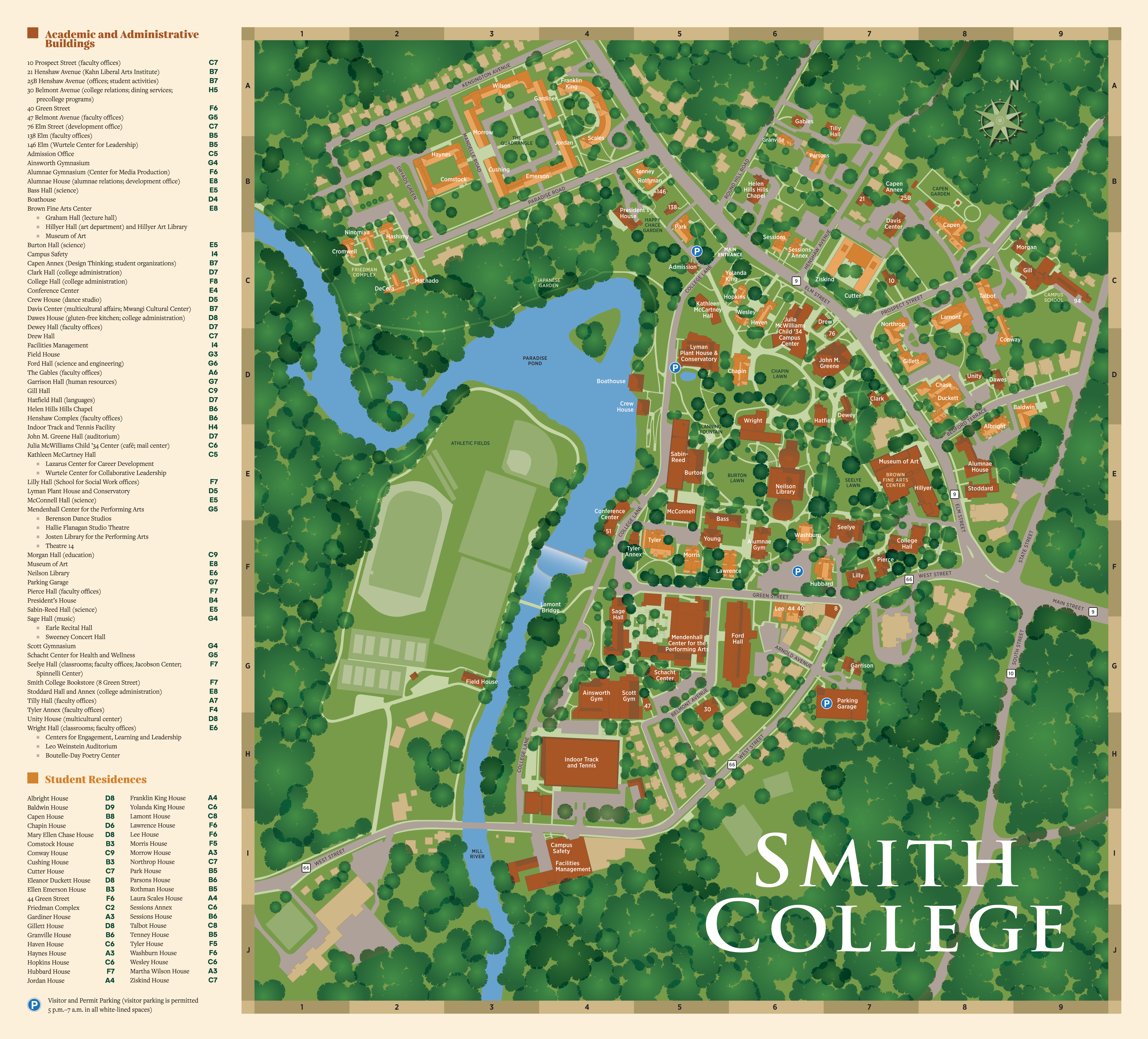
Life at Smith is defined by its unique house system. Unlike typical dormitories, Smith's 41 houses are self-governing communities where students from all four class years live together, often for their entire college career. This creates a immediate sense of belonging and a network of support that functions more like a family than a residence hall. The system is a major social engine: students eat family-style meals in their houses, participate in house traditions, and form deep, cross-generational friendships. As one student notes, "As a natural extrovert, you will find plenty of opportunities to socialize whenever you aren't in class: eating with your house, hanging out with other first..." This residential immersion is nearly universal, with 98% of students living in college-owned, -operated, or -affiliated housing. The campus, described as bringing together a "vast array of life experiences, spiritual and religious beliefs, and cultural backgrounds," is located in Northampton, Massachusetts—a famously progressive and vibrant small city with a rich arts and dining scene that serves as an extension of the campus. The college actively works to maintain a community "free from harassing behavior," aligning with its overall ethos of intentional, inclusive living.
A Smith education is a direct pipeline to postgraduate success. The college reports that within six months of graduation, 95% of the Class of 2025 were employed, enrolled in graduate or professional school, or otherwise pursuing their planned next step. This remarkable statistic underscores the effectiveness of Smith's academic preparation and powerful alumnae network. The college boasts a high graduation rate, with sources citing rates between 89% and 91%, which places it in the top tier nationally. According to the U.S. Department of Education's College Scorecard, the median earnings for Smith graduates ten years after entry are $64,027. This strong outcomes data reflects the value of a rigorous liberal arts degree from an institution known for producing leaders, particularly in STEM fields where women remain underrepresented.
Smith has launched one of the most aggressive and generous financial aid initiatives in higher education. Through its "Next 150" pledge, the college guarantees it will meet 100% of the demonstrated financial need for all admitted students who apply on time, and it does so with aid packages that contain no loans. This is a monumental commitment to accessibility. Furthermore, Smith has announced that families with annual incomes up to $150,000 will receive free tuition. For families with incomes above that threshold, aid is still substantial and loan-free. The average after aid—the actual cost a typical student pays—is $27,579. This policy transforms Smith from a selective liberal arts college into a need-blind institution for all U.S. applicants, fundamentally removing cost as a barrier for talented students from middle-income families. As the college states, this move is about "opening the college doors wider."
Smith stands out not for one reason, but for a powerful combination of them: it is a women's college that champions an open curriculum, a residential college built on a house system, and a wealthy institution that has chosen to spend its endowment on eliminating debt for its students. This triad creates a unique ecosystem. The open curriculum treats students as autonomous intellectuals, the house system provides a secure and vibrant community to navigate that freedom, and the no-loan financial aid policy ensures that community is built on economic equity, not privilege. It’s a place where a student can design a major in robotics, live in a house that feels like a home, and graduate into a powerful global network without the anchor of student debt. In an era where the value of liberal arts is constantly questioned, Smith answers with concrete data on postgraduate success and a radical financial commitment to access. It’s a college that doesn't just educate women; it empowers them to take intellectual, social, and financial risks from the moment they arrive on campus.
Smith College seal · sourceSmith College | Visit the Campus · sourceSmith College | Visit the Campus · sourceSmith College - Profile, Rankings and Data | US News Best Colleges · source