Admit rate has ranged 28%–34% over the last 5 years, though the latest figure above (26%) falls outside that window. Source: IPEDS via Urban Institute.
Acceptance & SAT from Common Data Set / IPEDS; net price, earnings & graduation from the U.S. Dept. of Education College Scorecard. Figures lag ~1–2 years — verify with the school.
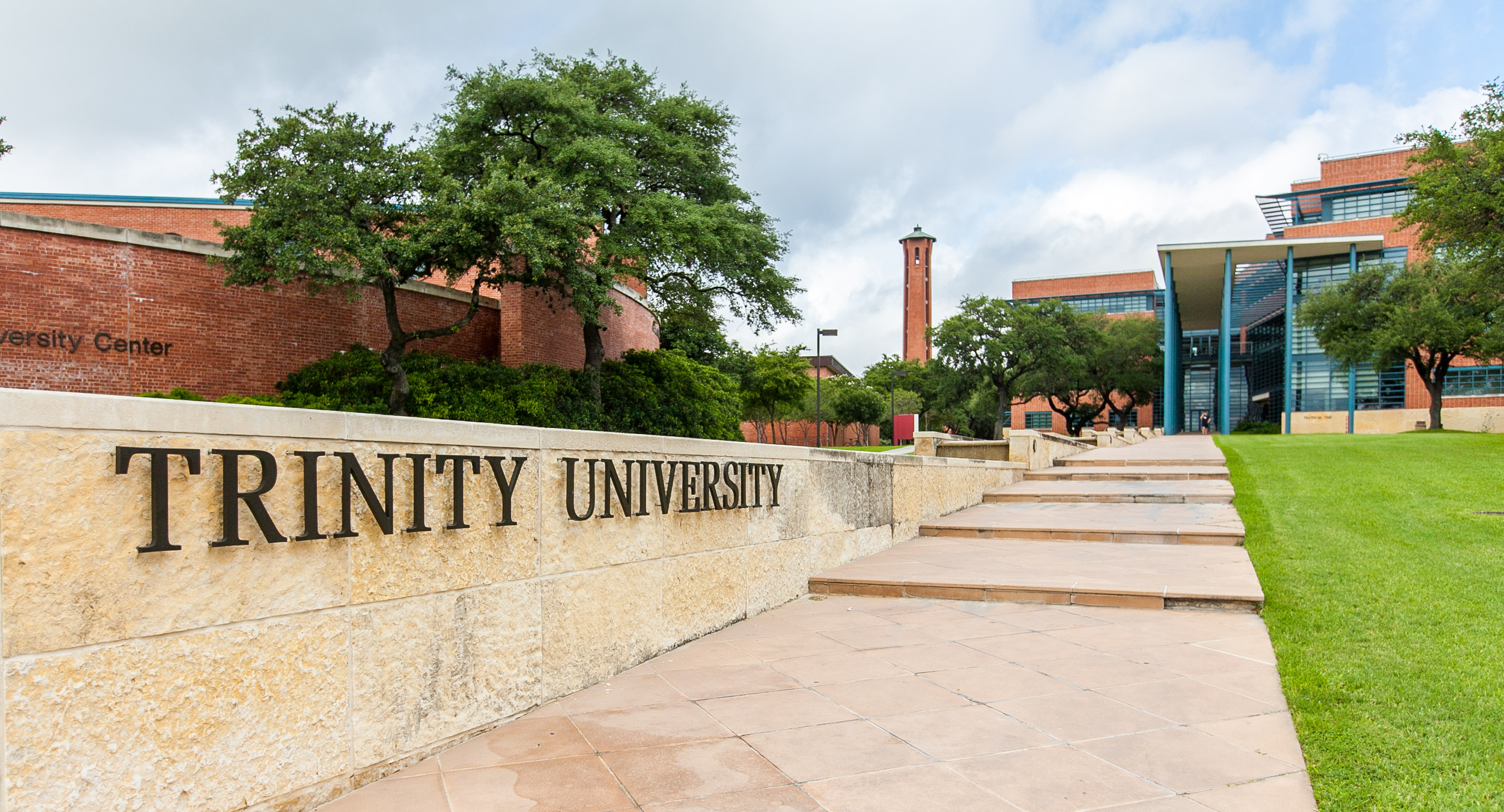
Trinity University is a selective, nationally-ranked liberal arts college in San Antonio that has quietly become one of the most compelling value propositions in the South. With a curriculum offering over 100 majors and minors, it pairs rigorous academics—particularly strong in STEM and business—with a sun-drenched, engaged campus culture. Its recent, meteoric rise in selectivity and its commitment to meeting full financial need position it as a serious contender for high-achieving students who want a classic liberal arts education without the Northeast price tag or pretension.
Admission requirements
Test-optional — scores considered if submitted
Required
High school transcript
Grade point average
Letters of recommendation
College-prep program
TOEFL (non-native English)
Considered (not required)
Class rank
Test scores (SAT/ACT)
Source: IPEDS Admissions survey (2022) via Urban Institute. Covers formal factors only — it does not reflect essays, extracurriculars, or other holistic criteria.
More details
Undergrad enrollment
2,505
In-state tuition
$53,676
Out-of-state tuition
$53,676
No-Loan Policy
Not Stated in Sources
Graduation Rate
84%
Meets Full Need
Yes
ED Share of Class
Not Stated in Sources
First-Year Retention
Not Stated in Sources
Demonstrated Interest
Check CDS C7
Median Earnings (10yr)
$71,668
Outcomes & value
Outcomes & value
Median earnings (10 yr)
$71,668
Value (earnings ÷ net price)
3.1×
Median debt at graduation
$22,954
Graduation rate
84%
First-year retention
93%
Reducing loan balance (3 yr)
86%
Pell (lower-income) share
19%
First-gen share (among federal-aid recipients)
17%
Financial health
3.0 / 3.0Meets the federal financial-responsibility standard
U.S. Dept. of Education Financial Responsibility Composite Score (FY2022-23). Scale −1.0 to 3.0; ≥1.5 meets the standard. Reported for private nonprofit & for-profit institutions only — public universities are state-backed and not scored, so this is a stability signal, not a ranking.
Top-earning majors
Median earnings by field of study (highest credential), ~2 years after completion.
Computer and Information Sciences, General$77,213
Finance and Financial Management Services$64,990
Engineering Science$60,320
Economics$52,107
Marketing$41,937
Romance Languages, Literatures, and Linguistics$40,485
Applicants here also applied to
The schools that most often appear alongside Trinity University on applicants’ lists, from our self-reported outcomes corpus.
Co-application frequency from self-reported results — directional peer discovery, not a recommendation.
Campus & location
Campus safety
On-campus violent crimes (2024)
4
Per 1,000 students
1.50
On-campus criminal offenses classed as violent (murder/non-negligent manslaughter, rape, robbery, aggravated assault) for the most recent reported year. Source: U.S. Dept. of Education Campus Safety and Security (Clery Act). Counts reflect what’s reported to the school, and urban campuses often report more partly due to non-student incidents nearby — read alongside campus size and setting, not as a standalone safety verdict.
Climate
Pleasant days / yr
108
Summer high
95°F
Winter low
46°F
Annual rain
37.8"
Annual snow
1"
Natural-hazard risk
Relatively High
Pleasant days counts days per year with a mean temperature of 55–75°F, a high at or below 90°F, a low at or above 45°F, and little precipitation — a transparent comfort measure, not a weighting we invented. Computed from Open-Meteo ERA5 daily history (2019–2023). Natural-hazard risk is the county’s composite rating from the FEMA National Risk Index.
Deep dive — research, future-scholar output & economic mobility▾
Research output
Institutional h-index
211
Scholarly works
7,889
Institutional research volume and impact from OpenAlex. The h-index reflects large research universities and will be low for teaching-focused liberal-arts colleges — not a measure of undergraduate quality.
Economic mobility
Mobility rate
1.2%
Bottom → top quintile
48%
From bottom quintile
2%
Mobility rate = the share of students who both start in the bottom household-income quintile and reach the top quintile; bottom → top is that chance conditional on starting at the bottom. Source: Opportunity Insights Mobility Report Cards (Chetty, Friedman, Saez, Turner & Yagan). Reflects 1980–82 birth cohorts, so it’s directional, not current.
Quick answers
What is the acceptance rate at Trinity University?
Trinity University's acceptance rate is approximately 26% (San Antonio, TX), based on the most recent figures we compiled from public and primary sources.
What SAT score do you need for Trinity University?
Admitted students at Trinity University typically score 1340–1500 on the SAT (the middle-50% range). Scores outside this band are still admitted, especially with strong applications.
How much does Trinity University cost?
At Trinity University, the average net price (after aid) is about $23,464 per year. Actual cost varies with financial aid and residency.
How many undergraduates attend Trinity University?
Trinity University enrolls approximately 2,505 undergraduate students.
Where is Trinity University located?
Trinity University is located in San Antonio, TX.
Admissions
Trinity's admissions landscape has tightened dramatically in recent years, transforming it from a regional favorite to a nationally competitive institution. The hit a record-breaking 28% for the Class of 2027, down from 31% the previous year, driven by over 11,400 applications. For the current cycle, the rate stands at 26%. The middle 50% SAT range for admitted students is 1340–1500, with an average of 1411, while the ACT middle 50% is 31–34, with a mean of 32. Nearly half (48%) of admitted students submitted a standardized test score. The unweighted GPA range for the middle 50% of admitted students is 3.7–4.0.
The Early Decision (ED) pathway offers a significant strategic advantage. Trinity's overall acceptance rate is 25% compared to 53% for Early Decision, making ED a powerful tool for demonstrating commitment. The rate for ED admits is effectively 100%, as these students are contractually bound to attend. The college's ED I cycle recently yielded a 99% enrollment rate. While the is the definitive source for standardized statistics, the level of an applicant's demonstrated interest—a key factor at many selective schools—must be checked within the CDS's C7 section to understand its importance at Trinity.
Trinity actively reviews a holistic set of factors beyond scores and grades, seeking students who are intellectually curious and motivated to take an active role in their education.
Earnings = median of students working ~10 years after entry; debt = median of graduates. Value divides 10-yr earnings by one year’s net price — read it as earnings per dollar of annual cost, not a full lifetime ROI; it favors lower-cost schools. Source: U.S. Dept. of Education College Scorecard. Figures lag ~2 years and reflect all students, not your intended major.
Communication and Media Studies
$36,848
Urban Studies/Affairs$31,670
Source: U.S. Dept. of Education College Scorecard (field-of-study earnings). Figures cover graduates who received federal aid and lag ~2 years; not all programs report data.
Trinity's academic engine is built on a broad, deep liberal arts foundation, offering more than 100 majors, minors, and interdisciplinary programs. The curriculum is designed for students ready to craft their own educational path, with opportunities for undergraduate research woven throughout. The university is consistently ranked #1 for Best Liberal Arts College in Texas and #19 for Best Small College in America by Niche.
Popular majors reflect a balance between the humanities, sciences, and professional fields. According to recent data, the most common areas of study include Psychology (6%), Computer and Information Sciences (5%), Mathematics and Statistics (4%), and Foreign Languages, Literatures, and Linguistics. The Michael Neidorff School of Business is a notable strength. The university attracts top-tier talent across STEM, arts, humanities, and social sciences, fostering an environment where intellectual curiosity is the baseline expectation. The Princeton Review notes Trinity is an ideal fit for students who are motivated to work hard and engage actively in their learning.
Life at Trinity is defined by an inclusive, engaged community set on a beautiful campus in the heart of San Antonio. The university strives to be a diverse environment where students can engage in difficult dialogues, explore cultures, and find common bonds. Student Affairs is dedicated to cultivating an experience where students form new relationships, encounter new ideas, and develop mind, body, and spirit.
Outside the classroom, the campus pulses with activity. Students can choose from club and intramural sports, Greek life, campus publications, academic groups, music ensembles, and a wide array of hobby clubs. This active life outside the classroom is considered an integral part of the college experience, with many students exploring the varied cultural, political, and social offerings of San Antonio itself. Reviews highlight a generally friendly and collaborative campus atmosphere, where students are academically focused but also make time for a rich tapestry of extracurriculars.
Trinity delivers strong outcomes that validate its investment, earning it repeated recognition as a Best Value College. The Princeton Review recently gave it a rising score of 92/99 for Return on Investment. The university's graduation rate is a robust 82%, placing it in the top 10% of institutions nationwide. The four-year graduation rate is 72%.
Financially, graduates see a significant payoff. The median earnings ten years after entry are $71,668. Other sources note a median salary of $55,224 six years after graduation, and an average starting salary for recent business school graduates of $69,000. Compared to the earnings of high school graduates, Trinity alumni see a substantial median earnings premium. These strong outcomes in graduation and earnings underpin Trinity's value proposition, blending a high-quality liberal arts education with a clear pathway to professional success.
Trinity is committed to affordability and meeting the full demonstrated financial need of its students. The average after aid is $23,464. The university encourages families to use its Net Price Calculator to estimate financial assistance and determine affordability.
Financial aid packages are built on a foundation of need-based grants, which are gift aid funded from federal, state, and institutional sources. The university maintains a policy of meeting 100% of a student's demonstrated need. Loans are also available, both need-based and non-need-based, with continued eligibility requiring completion of the FAFSA. Merit-based scholarships are prevalent, with most accepted students qualifying for awards ranging from $10,000 to $30,000 per academic year. Approximately 38.2% of students receive financial aid, with an average aid package of $52,568.
Trinity University stands out for its potent combination of rising selectivity, academic strength, and unwavering commitment to value. It's not just climbing the rankings; it's fundamentally changing its student profile, attracting higher-caliber applicants each year while maintaining a generous financial aid philosophy. Unlike many peers that have become prohibitively expensive, Trinity meets full need, ensuring access.
Its location in San Antonio provides a dynamic, culturally rich urban backdrop distinct from the typical isolated liberal arts college setting. The curriculum offers both the breadth of a classic liberal arts education and the depth of pre-professional programs like its highly-regarded business school. The result is a graduate who is both broadly educated and immediately employable, evidenced by strong median earnings. Trinity represents a savvy choice: the intellectual rigor and community of a top-tier liberal arts college, delivered with a distinctly Texan confidence and a clear-eyed focus on return on investment.
Trinity University seal · sourceUniversity History | About Trinity | Trinity University · sourceTrinity University - Trinity In Focus - Open House Events · sourceWelcome to Trinity College | Trinity College · source