Loading…
← All schools
California State University-Fullerton
Fullerton, CApublicfullerton.edu
Acceptance
91%
Avg net price
$6,555
Earnings (10 yr)
$62,951
Graduation rate
70%
Admit rate has ranged 53%–87% over the last 5 years — notably volatile, though the latest figure above (91%) falls outside that window. Source: IPEDS via Urban Institute.
Acceptance & SAT from Common Data Set / IPEDS; net price, earnings & graduation from the U.S. Dept. of Education College Scorecard. Figures lag ~1–2 years — verify with the school.
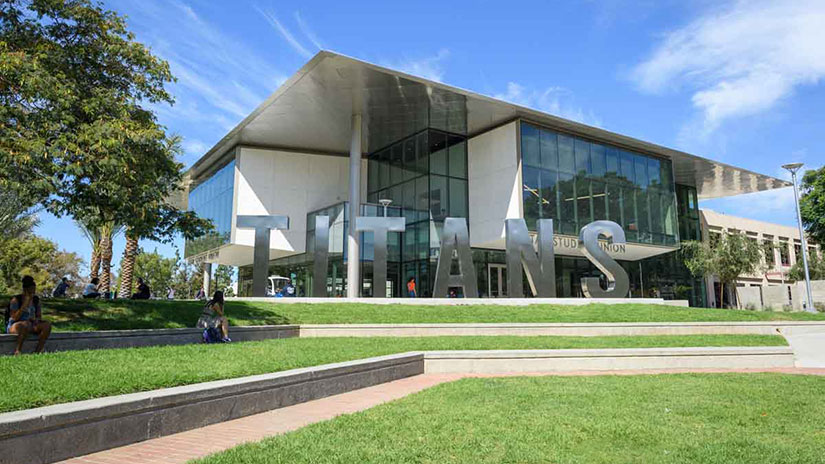
California State University-Fullerton is a massive, sprawling public university that defines the modern commuter-campus experience in Southern California. It's an engine of social mobility, known for its pragmatic, career-focused education—particularly in business, engineering, and the arts—that delivers strong outcomes at a remarkably low net price. The vibe is self-directed and decentralized: you get out what you put in, with a vast menu of academic programs and over 300 clubs, but the onus is on the student to forge a community from the sea of 40,000 faces.
Admission requirements
Test-blind — scores not considered
Required
- High school transcript
- Grade point average
- College-prep program
- TOEFL (non-native English)
Source: IPEDS Admissions survey (2022) via Urban Institute. Covers formal factors only — it does not reflect essays, extracurriculars, or other holistic criteria.
More details
- Undergrad enrollment
- 38,546
- In-state tuition
- $7,470
- Out-of-state tuition
- $20,070
- No-Loan Policy
- No
- Graduation Rate
- 70%
- Meets Full Need
- No
- On-Campus Housing
- 3%
- Demonstrated Interest
- Not considered
- Median Earnings (10yr)
- $62,951
Outcomes & value
Outcomes & value
- Median earnings (10 yr)
- $62,951
- Value (earnings ÷ net price)
- 9.6×
- Median debt at graduation
- $13,750
- Graduation rate
- 70%
- First-year retention
- 82%
- Reducing loan balance (3 yr)
- 70%
- Pell (lower-income) share
- 48%
- First-gen share (among federal-aid recipients)
- 49%
Top-earning majors
Median earnings by field of study (highest credential), ~2 years after completion.
- Registered Nursing, Nursing Administration, Nursing Research and Clinical Nursing$86,042
- Computer Science$67,101
- Electrical, Electronics, and Communications Engineering$65,610
- Mechanical Engineering$62,792
- Civil Engineering$60,117
- Economics$52,733
Applicants here also applied to
The schools that most often appear alongside California State University-Fullerton on applicants’ lists, from our self-reported outcomes corpus.
Campus & location
Campus safety
- On-campus violent crimes (2024)
- 7
- Per 1,000 students
- 0.16
On-campus criminal offenses classed as violent (murder/non-negligent manslaughter, rape, robbery, aggravated assault) for the most recent reported year. Source: U.S. Dept. of Education Campus Safety and Security (Clery Act). Counts reflect what’s reported to the school, and urban campuses often report more partly due to non-student incidents nearby — read alongside campus size and setting, not as a standalone safety verdict.
Climate
- Pleasant days / yr
- 252
- Summer high
- 84°F
- Winter low
- 48°F
- Annual rain
- 17.9"
- Natural-hazard risk
- Very High
Pleasant days counts days per year with a mean temperature of 55–75°F, a high at or below 90°F, a low at or above 45°F, and little precipitation — a transparent comfort measure, not a weighting we invented. Computed from Open-Meteo ERA5 daily history (2019–2023). Natural-hazard risk is the county’s composite rating from the FEMA National Risk Index.
Deep dive — research, future-scholar output & economic mobility
Research output
- Institutional h-index
- 460
- Scholarly works
- 22,261
Institutional research volume and impact from OpenAlex. The h-index reflects large research universities and will be low for teaching-focused liberal-arts colleges — not a measure of undergraduate quality.
Economic mobility
- Mobility rate
- 4.8%
- Bottom → top quintile
- 40%
- From bottom quintile
- 12%
Mobility rate = the share of students who both start in the bottom household-income quintile and reach the top quintile; bottom → top is that chance conditional on starting at the bottom. Source: Opportunity Insights Mobility Report Cards (Chetty, Friedman, Saez, Turner & Yagan). Reflects 1980–82 birth cohorts, so it’s directional, not current.
Quick answers
- What is the acceptance rate at California State University-Fullerton?
- California State University-Fullerton's acceptance rate is approximately 91% (Fullerton, CA), based on the most recent figures we compiled from public and primary sources.
- How much does California State University-Fullerton cost?
- At California State University-Fullerton, the average net price (after aid) is about $6,555 per year. Actual cost varies with financial aid and residency.
- How many undergraduates attend California State University-Fullerton?
- California State University-Fullerton enrolls approximately 38,546 undergraduate students.
- Where is California State University-Fullerton located?
- California State University-Fullerton is located in Fullerton, CA.
Admissions
Cal State Fullerton is an open-access public university with a high , designed to serve a broad swath of California students. The admissions process is formulaic and transparent, focused on meeting the California State University's statewide eligibility requirements. The university does not use ACT or SAT scores in determining admission eligibility, a policy that underscores its commitment to accessible, test-blind admissions. While the overall acceptance rate is high, it's important to note that specific, high-demand majors may have more stringent supplemental requirements or impaction, meaning admission to the university does not guarantee admission to every program. The process is not about curating a small, elite class but about evaluating whether applicants meet the baseline academic thresholds for success within the CSU system.
- Test Policy: The California State University has discontinued the use of ACT/SAT examinations in determining admission eligibility.
- Admission Factors: The process relies on the statewide CSU eligibility index, which combines GPA and coursework completion. Demonstrated interest, such as campus visits or communication with admissions officers, is not a factor in decisions—it's a purely numbers-driven evaluation of academic preparation.
- Yield: A relatively low percentage of admitted students choose to enroll, which is typical for a commuter-focused public university where many applicants are also considering other CSU campuses or local community colleges.
Compare California State University-Fullerton
vs Louisiana State University and Agricultural & Mechanical Collegevs Oklahomavs University of Colorado Denver/Anschutz Medical Campusvs University of Houston
See colleges similar to California State University-Fullerton →Sources
- Common Data Set | California State University Long Beach
- Common Data Set: Home
- [PDF] Common Data Set 2024-2025 - Cal State LA
- The Common Data Set: What It Is & How to Use It In College ...
- Common Data Set Repository - College Transitions
- Common Data Set - GradGPT
- California State University: Fullerton Admissions - BigFuture
- Cal State Fullerton SAT Scores and GPA - PrepScholar
- California State University--Fullerton Admissions Stats
- First Year Admissions Requirements | CSUF
- Cal State Fullerton 2018 Acceptance Rate: Class of 2022 - Prep Expert