Admit rate has ranged 30%–38% over the last 5 years, though the latest figure above (28%) falls outside that window. Source: IPEDS via Urban Institute.
Acceptance & SAT from Common Data Set / IPEDS; net price, earnings & graduation from the U.S. Dept. of Education College Scorecard. Figures lag ~1–2 years — verify with the school.
Franklin & Marshall College is a residential liberal arts college in Lancaster, Pennsylvania, that combines rigorous, exploratory academics with a surprisingly pragmatic focus on post-graduate success. With a 9:1 student-to-faculty ratio and a curriculum built for intellectual wandering across 52 majors and minors, F&M cultivates a culture where close mentorship is the norm. Its defining characteristic might be the tangible return on investment: graduates' early-career earnings significantly outpace national averages, backed by a career outcomes engine that places over 90% of graduates in jobs or further education within six months.
Admission requirements
Test-optional — scores considered if submitted
Required
High school transcript
Grade point average
Letters of recommendation
College-prep program
TOEFL (non-native English)
Considered (not required)
Class rank
Test scores (SAT/ACT)
Demonstrated competencies
Source: IPEDS Admissions survey (2022) via Urban Institute. Covers formal factors only — it does not reflect essays, extracurriculars, or other holistic criteria.
More details
Undergrad enrollment
1,799
In-state tuition
$70,794
Out-of-state tuition
$70,794
No-Loan Policy
No (but has tuition-free guarantee for specific population)
Graduation Rate
84%
Meets Full Need
Tuition-free guarantee for qualifying PA residents (Commonwealth Commitment)
ED Share of Class
Just under 72%
Demonstrated Interest
Considered
Median Earnings (10yr)
$76,124
Student-to-Faculty Ratio
9:1
First-Year Retention Rate
Not stated in sources
Outcomes & value
Outcomes & value
Median earnings (10 yr)
$76,124
Value (earnings ÷ net price)
2.1×
Median debt at graduation
$19,000
Graduation rate
84%
First-year retention
90%
Reducing loan balance (3 yr)
85%
Pell (lower-income) share
16%
First-gen share (among federal-aid recipients)
19%
Financial health
2.8 / 3.0Meets the federal financial-responsibility standard
U.S. Dept. of Education Financial Responsibility Composite Score (FY2022-23). Scale −1.0 to 3.0; ≥1.5 meets the standard. Reported for private nonprofit & for-profit institutions only — public universities are state-backed and not scored, so this is a stability signal, not a ranking.
Top-earning majors
Median earnings by field of study (highest credential), ~2 years after completion.
Economics$55,964
Business Administration, Management and Operations$52,733
Multi/Interdisciplinary Studies, Other$42,682
Political Science and Government$41,441
History$39,009
Public Health$38,337
Applicants here also applied to
The schools that most often appear alongside Franklin and Marshall College on applicants’ lists, from our self-reported outcomes corpus.
Co-application frequency from self-reported results — directional peer discovery, not a recommendation.
Campus & location
Campus safety
On-campus violent crimes (2024)
2
On-campus criminal offenses classed as violent (murder/non-negligent manslaughter, rape, robbery, aggravated assault) for the most recent reported year. Source: U.S. Dept. of Education Campus Safety and Security (Clery Act). Counts reflect what’s reported to the school, and urban campuses often report more partly due to non-student incidents nearby — read alongside campus size and setting, not as a standalone safety verdict.
Climate
Pleasant days / yr
89
Summer high
84°F
Winter low
29°F
Annual rain
46.4"
Annual snow
16.1"
Natural-hazard risk
Relatively High
Pleasant days counts days per year with a mean temperature of 55–75°F, a high at or below 90°F, a low at or above 45°F, and little precipitation — a transparent comfort measure, not a weighting we invented. Computed from Open-Meteo ERA5 daily history (2019–2023). Natural-hazard risk is the county’s composite rating from the FEMA National Risk Index.
Deep dive — research, future-scholar output & economic mobility▾
Research output
Institutional h-index
197
Scholarly works
5,733
Institutional research volume and impact from OpenAlex. The h-index reflects large research universities and will be low for teaching-focused liberal-arts colleges — not a measure of undergraduate quality.
Economic mobility
Mobility rate
1.3%
Bottom → top quintile
56%
From bottom quintile
2%
Mobility rate = the share of students who both start in the bottom household-income quintile and reach the top quintile; bottom → top is that chance conditional on starting at the bottom. Source: Opportunity Insights Mobility Report Cards (Chetty, Friedman, Saez, Turner & Yagan). Reflects 1980–82 birth cohorts, so it’s directional, not current.
Quick answers
What is the acceptance rate at Franklin and Marshall College?
Franklin and Marshall College's acceptance rate is approximately 28% (Lancaster, PA), based on the most recent figures we compiled from public and primary sources.
What SAT score do you need for Franklin and Marshall College?
Admitted students at Franklin and Marshall College typically score 1310–1463 on the SAT (the middle-50% range). Scores outside this band are still admitted, especially with strong applications.
How much does Franklin and Marshall College cost?
At Franklin and Marshall College, the average net price (after aid) is about $36,425 per year. Actual cost varies with financial aid and residency.
How many undergraduates attend Franklin and Marshall College?
Franklin and Marshall College enrolls approximately 1,799 undergraduate students.
Where is Franklin and Marshall College located?
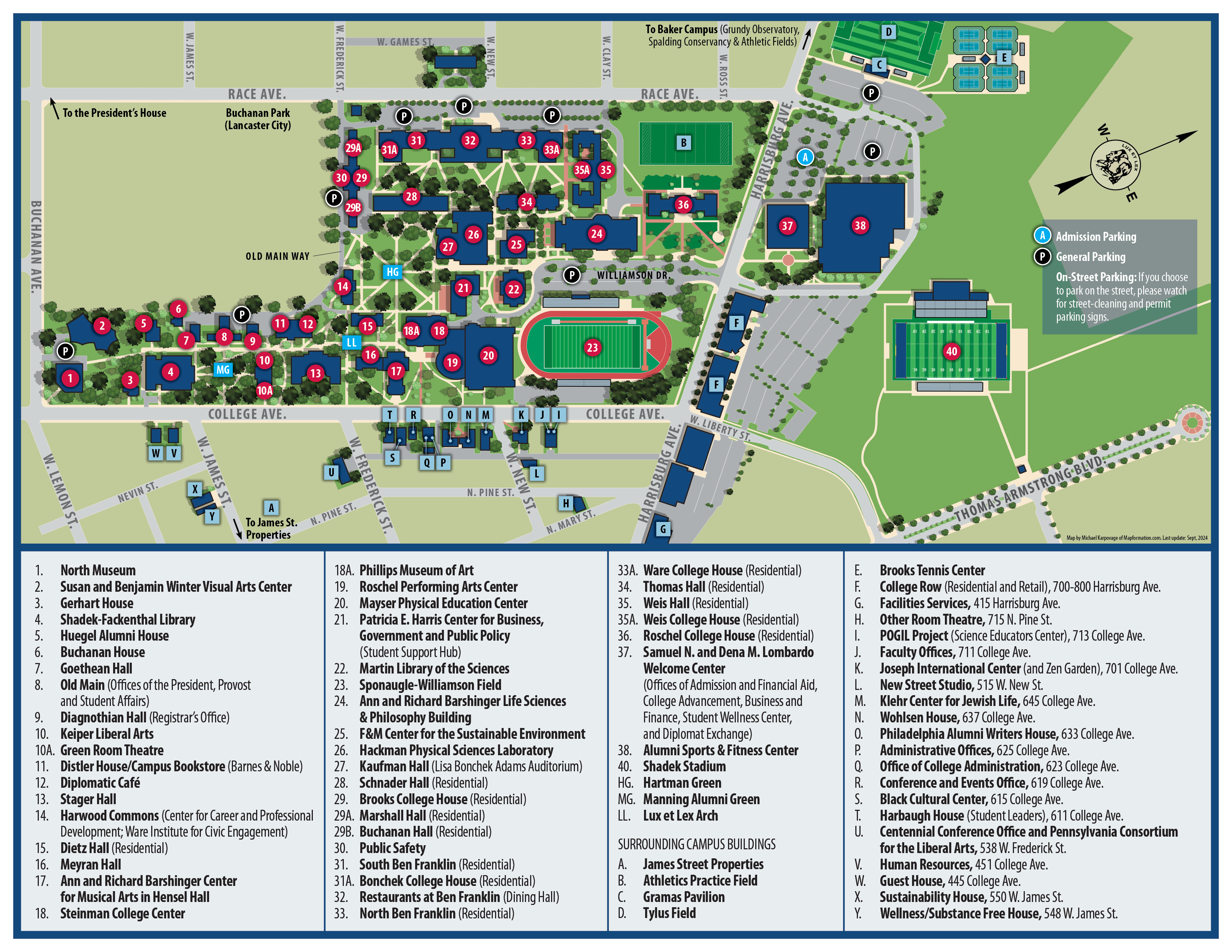
Franklin and Marshall College is located in Lancaster, PA.
Admissions
Gaining admission to Franklin & Marshall is a selective proposition, with the college admitting roughly 28% of its applicants. The middle 50% SAT range for admitted students is 1310–1463, and the ACT range is 30–33. The admissions process is holistic, considering a range of factors beyond test scores. According to its , the college considers an applicant's level of interest in attending. While the exact weight isn't specified, this policy means that demonstrated interest—through campus visits, interviews, or engagement with admissions representatives—is a factor in the evaluation.
Applying Early Decision (ED) appears to confer a significant advantage. While the overall is 28%, one analysis of ED rates placed Franklin & Marshall's combined ED I and II acceptance rate at 29.53% for a recent cycle. Furthermore, data suggests the college fills a substantial portion of its incoming class through binding early decision plans; one source indicates they fill just under 72% of their class with ED admits. For the Class of 2030, the college welcomed nearly 200 students via Early Decision. The incoming class is notably diverse, with 16% college students and 18% eligible for Federal Pell Grants.
Earnings = median of students working ~10 years after entry; debt = median of graduates. Value divides 10-yr earnings by one year’s net price — read it as earnings per dollar of annual cost, not a full lifetime ROI; it favors lower-cost schools. Source: U.S. Dept. of Education College Scorecard. Figures lag ~2 years and reflect all students, not your intended major.
Natural Resources Conservation and Research
$36,848
Psychology, General$36,848
Source: U.S. Dept. of Education College Scorecard (field-of-study earnings). Figures cover graduates who received federal aid and lag ~2 years; not all programs report data.
Franklin & Marshall's academic identity is firmly rooted in the liberal arts, with a model specifically designed for intellectual exploration. Students can choose from 52 majors and minors, supported by an intimate 9:1 student-to-faculty ratio that facilitates close mentorship and collaborative research. The most popular majors reflect a blend of scientific inquiry and humanistic study: Biology/Biological Sciences, Creative Writing, Neuroscience, Sociology, and Biochemistry are among the top choices.
The college encourages interdisciplinary study through programs like Science, Technology and Society (STS), which allows students to delve into fields like biomedical ethics, the history and philosophy of science, and science-based policy. This balance between depth and breadth creates what observers describe as a "strong and competitive academic culture" that doesn't sacrifice a vibrant campus life. The academic experience is uniformly undergraduate-focused and residential, dedicated to excellence in liberal arts education.
As a fully residential college, campus life is central to the F&M experience. The college fosters a community where, according to student perspectives, a great balance is struck between a demanding academic culture, successful NCAA Division III athletic teams (the Diplomats), and an active social scene. This blend suggests a campus where students are serious about their studies but equally engaged in the broader collegiate experience of athletics, clubs, and social events. The residential nature ensures that this vibrant life is immersive and shared, creating a tight-knit community on campus in the historic city of Lancaster.
Franklin & Marshall's most compelling selling point is the powerful career launch it provides its graduates. The college reports that 92% of the Class of 2025 were either employed or furthering their education within six months of graduation—a rate it notes is higher than the national average. The financial payoff is significant: graduates report an early career median salary of $76,124, which the college states is more than $20,000 higher than the midpoint for four-year college graduates nationally. Longer-term data supports this strong start; the median salary six years after graduation is reported as $62,544. These figures underscore a clear return on investment from an F&M liberal arts degree, backed by a dedicated "Success Beyond F&M" infrastructure that actively connects students with opportunities.
Franklin & Marshall is committed to making its education accessible through a robust financial aid program. The average after aid is $36,425. A significant majority of students—57.69%—receive financial aid, with the average aid package totaling $56,192. The college utilizes a Net Price Calculator to help families estimate their actual cost.
A cornerstone of its affordability efforts is the F&M Commonwealth Commitment, a promise to Pennsylvania residents from families with adjusted gross incomes of $100,000 or less and typical assets. This commitment ensures that these students will have their full tuition charge covered by grant-based financial aid, effectively making tuition free for qualifying families. It's important to note that this is a tuition-free guarantee, not a universal no-loan policy for all students. The college's financial aid packages include federal loans for those who qualify, and it notes that for students qualifying for , additional benefits can be layered on top of the package.
Franklin & Marshall distinguishes itself by masterfully bridging the traditional liberal arts ideal with 21st-century outcomes. It offers the classic hallmarks of a top-tier liberal arts college—a 9:1 student-to-faculty ratio, a curriculum built for exploration across 52 fields, and a fully residential community—but then doubles down on ensuring that education translates into tangible success. The data is persuasive: a 92% post-graduate placement rate within six months and median early-career earnings that dramatically outpace national averages. This is not an accident but the result of a clear institutional focus, embodied by initiatives like the Commonwealth Commitment, which makes tuition free for qualifying Pennsylvania families, and a pervasive culture of mentorship. F&M proves that deep intellectual engagement and practical career preparation are not mutually exclusive; here, they are intentionally woven together, producing graduates who are both broadly educated and immediately competitive.