Loading…
← All schools
Acceptance
85%
SAT 25–75
1180–1360
Avg net price
$19,680
Earnings (10 yr)
$67,253
Graduation rate
81%
Admit rate has ranged 71%–88% over the last 5 years — notably volatile. Source: IPEDS via Urban Institute.
Acceptance & SAT from Common Data Set / IPEDS; net price, earnings & graduation from the U.S. Dept. of Education College Scorecard. Figures lag ~1–2 years — verify with the school.
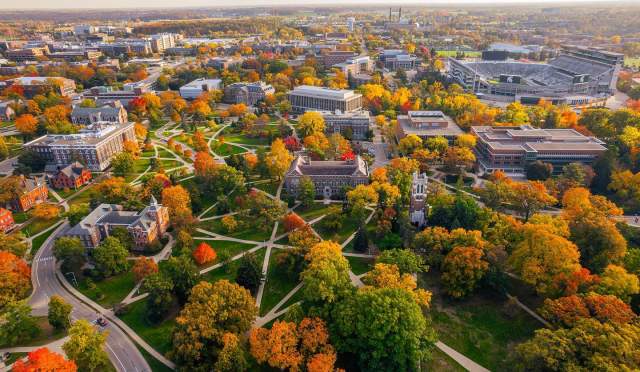
Michigan State University is a sprawling, high-energy public research powerhouse in East Lansing, defined by its accessible admissions, a massive academic portfolio of over 400 programs, and a quintessential Big Ten campus culture. It’s a place where world-class research in fields like education and business coexists with a famously vibrant social scene, creating an experience that is both deeply traditional and remarkably broad in its opportunities. For tens of thousands of students, it’s the quintessential large-state-university experience, offering a clear path from a strong high school record to a degree with solid career outcomes.
Admission requirements
Test-optional — scores considered if submitted
Required
- Grade point average
- College-prep program
- TOEFL (non-native English)
Considered (not required)
- Letters of recommendation
- Test scores (SAT/ACT)
Source: IPEDS Admissions survey (2022) via Urban Institute. Covers formal factors only — it does not reflect essays, extracurriculars, or other holistic criteria.
More details
- Undergrad enrollment
- 40,922
- In-state tuition
- $16,458
- Out-of-state tuition
- $43,842
- Early Decision
- Not offered
- Graduation Rate
- 81%
- Housing On-Campus
- 41%
- Programs of Study
- 400+
- First-Year Class Size
- 9,376
- Median Earnings (10yr)
- $67,253
Outcomes & value
Outcomes & value
- Median earnings (10 yr)
- $67,253
- Value (earnings ÷ net price)
- 3.4×
- Median debt at graduation
- $23,250
- Graduation rate
- 81%
- First-year retention
- 90%
- Reducing loan balance (3 yr)
- 67%
- Pell (lower-income) share
- 20%
- First-gen share (among federal-aid recipients)
- 21%
Top-earning majors
Median earnings by field of study (highest credential), ~2 years after completion.
- Computer Engineering$80,133
- Electrical, Electronics, and Communications Engineering$77,115
- Mechanical Engineering$75,936
- Computer and Information Sciences, General$75,291
- Chemical Engineering$71,351
- Materials Engineering$69,338
Applicants here also applied to
The schools that most often appear alongside Michigan State on applicants’ lists, from our self-reported outcomes corpus.
Campus & location
Campus safety
- On-campus violent crimes (2024)
- 61
- Per 1,000 students
- 1.18
On-campus criminal offenses classed as violent (murder/non-negligent manslaughter, rape, robbery, aggravated assault) for the most recent reported year. Source: U.S. Dept. of Education Campus Safety and Security (Clery Act). Counts reflect what’s reported to the school, and urban campuses often report more partly due to non-student incidents nearby — read alongside campus size and setting, not as a standalone safety verdict.
Climate
- Pleasant days / yr
- 90
- Summer high
- 81°F
- Winter low
- 21°F
- Annual rain
- 36.2"
- Annual snow
- 35.4"
- Natural-hazard risk
- Relatively Moderate
Pleasant days counts days per year with a mean temperature of 55–75°F, a high at or below 90°F, a low at or above 45°F, and little precipitation — a transparent comfort measure, not a weighting we invented. Computed from Open-Meteo ERA5 daily history (2019–2023). Natural-hazard risk is the county’s composite rating from the FEMA National Risk Index.
Deep dive — research, future-scholar output & economic mobility
Research output
- Institutional h-index
- 1,064
- Scholarly works
- 247,350
Institutional research volume and impact from OpenAlex. The h-index reflects large research universities and will be low for teaching-focused liberal-arts colleges — not a measure of undergraduate quality.
Future-scholar output
Science & engineering PhDstop 22 nationally
Humanities & social-science PhDstop 18 nationally
Share of this school’s graduates who go on to earn research doctorates (2010–20), by national rank and per-capita yield (NSF institutional-yield ratio). A signal of a research-oriented student culture — not a causal promise, since it partly reflects who enrolls. Only top producers appear. Source: NSF NCSES, Baccalaureate Origins of U.S. Research Doctorate Recipients.
Economic mobility
- Mobility rate
Quick answers
- What is the acceptance rate at Michigan State University?
- Michigan State University's acceptance rate is approximately 85% (East Lansing, MI), based on the most recent figures we compiled from public and primary sources.
- What SAT score do you need for Michigan State University?
- Admitted students at Michigan State University typically score 1180–1360 on the SAT (the middle-50% range). Scores outside this band are still admitted, especially with strong applications.
- How much does Michigan State University cost?
- At Michigan State University, the average net price (after aid) is about $19,680 per year. Actual cost varies with financial aid and residency.
- How many undergraduates attend Michigan State University?
- Michigan State University enrolls approximately 40,922 undergraduate students.
- Where is Michigan State University located?
- Michigan State University is located in East Lansing, MI.
Admissions
Michigan State operates with a high-access admissions philosophy, welcoming the vast majority of its applicants. For the most recent class, the university received 62,965 applications and admitted 52,411 students, resulting in an of 85%.
The middle 50% of enrolled first-year students present strong but not stratospheric academic credentials: an unweighted high school GPA between 3.5 and 4.0, an SAT score between 1180 and 1360, and an ACT composite between 26 and 31. The average unweighted GPA for admitted students is 3.74. This profile positions MSU as a realistic target for well-prepared students from across Michigan and beyond.
MSU does not offer an Early Decision program, and its rate—the percentage of admitted students who choose to enroll—has been reported as below 20%, a figure common for public universities with high acceptance rates. The application fee is $75.
Academics
MSU’s academic identity is built on scale, choice, and specific areas of deep excellence. The university is organized into 16 degree-granting colleges that offer more than 400 undergraduate, graduate, and certificate programs. This sheer volume means students can find a path for nearly any interest, from the expected to the highly specialized.
Compare Michigan State
See colleges similar to Michigan State →Sources
- Common Data Set - Institutional Research - Michigan State University
- Common Data Set | Office of Institutional Research & Effectiveness
- Common Data Set - Office of Budget and Planning
- Michigan State University Facts and Statistics: Home
- Michigan State University 2026 Common Data Set - GradGPT
- Common Data Set Repository - College Transitions
- First-year admission criteria | Michigan State University
- Michigan State SAT Scores and GPA - PrepScholar
- Michigan State University Admissions - BigFuture College Search
- Admission criteria | International applicants | Michigan State University
- Google claims MSU has an 88% acceptance rate– would you argue ...