Admit rate has ranged 43%–60% over the last 5 years — notably volatile. Source: IPEDS via Urban Institute.
Acceptance & SAT from Common Data Set / IPEDS; net price, earnings & graduation from the U.S. Dept. of Education College Scorecard. Figures lag ~1–2 years — verify with the school.
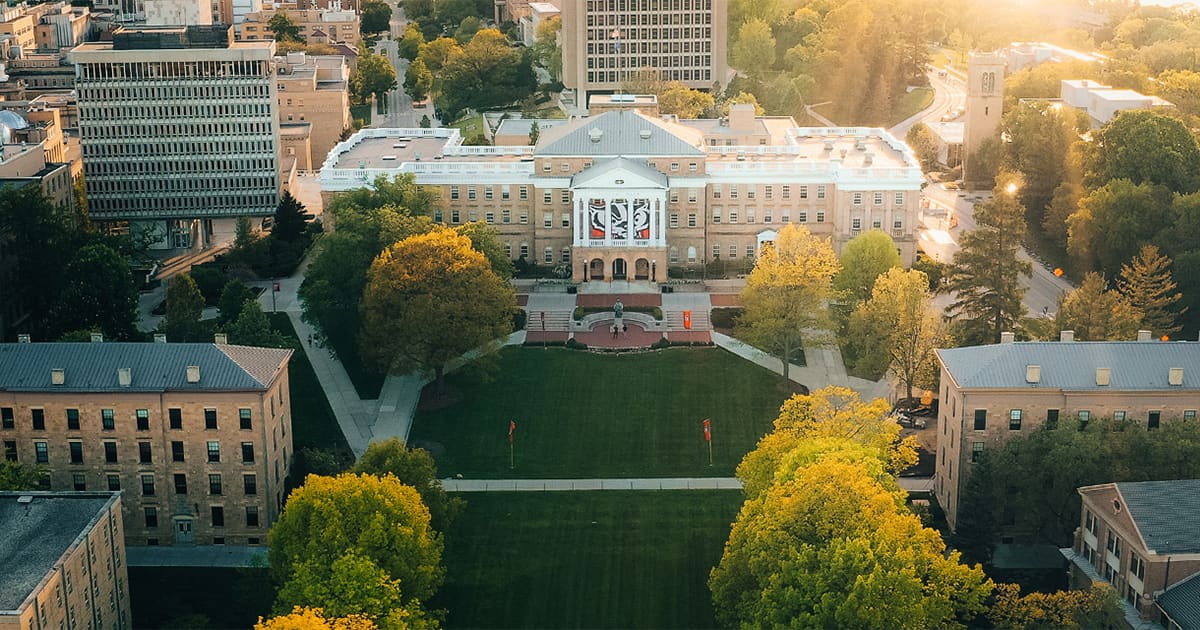
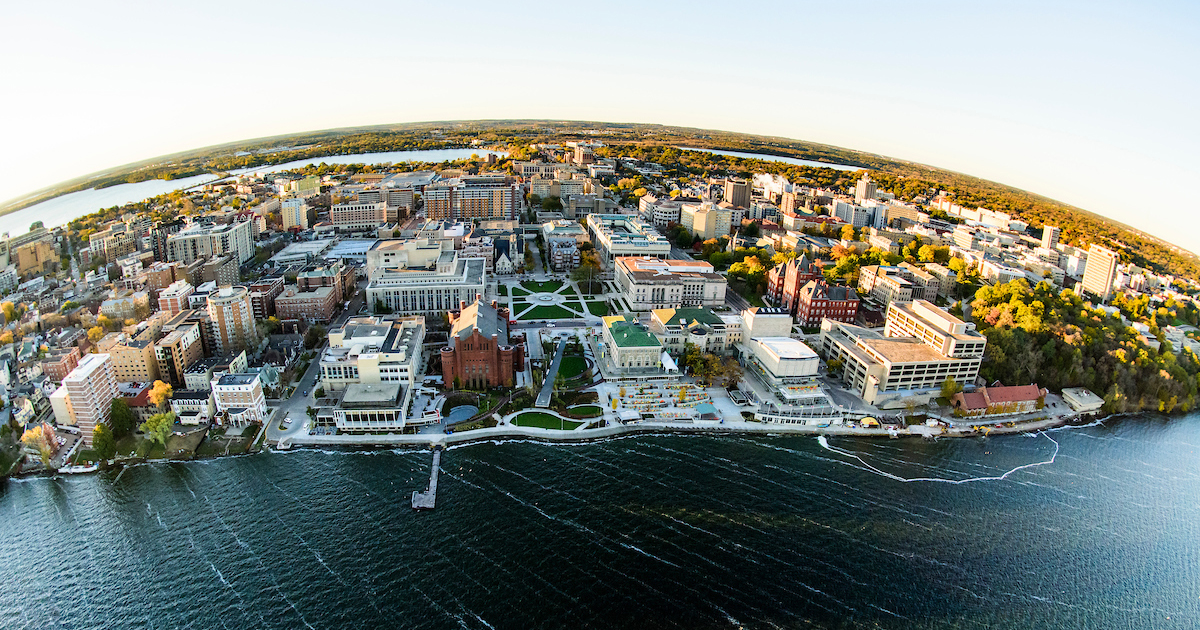
The University of Wisconsin-Madison is a powerhouse public research university where a 90% graduation rate and a famously vibrant social scene coexist on a stunning lakeside campus. With a 45% acceptance rate, it selects a class ready to dive into over 200 majors and top-tier research, all fueled by quintessential Big Ten energy. The investment pays off, with graduates earning a median of $73,792 a decade after starting, proving its 'work hard, play hard' ethos delivers.
Admission requirements
Test-optional — scores considered if submitted
Required
High school transcript
Grade point average
Letters of recommendation
College-prep program
TOEFL (non-native English)
Considered (not required)
Class rank
Test scores (SAT/ACT)
Source: IPEDS Admissions survey (2022) via Urban Institute. Covers formal factors only — it does not reflect essays, extracurriculars, or other holistic criteria.
More details
Undergrad enrollment
36,902
In-state tuition
$11,603
Out-of-state tuition
$42,103
Student-Faculty Ratio
18:1
4-Year Graduation Rate
89%
Percent Receiving Financial Aid
29%
Median Earnings 10 Years Post-Grad
$79,684
Outcomes & value
Outcomes & value
Median earnings (10 yr)
$73,792
Value (earnings ÷ net price)
4.3×
Median debt at graduation
$20,484
Graduation rate
90%
First-year retention
96%
Reducing loan balance (3 yr)
84%
Pell (lower-income) share
16%
First-gen share (among federal-aid recipients)
17%
Top-earning majors
Median earnings by field of study (highest credential), ~2 years after completion.
Computer Engineering$81,997
Management Sciences and Quantitative Methods$78,814
Computer and Information Sciences, General$75,282
Real Estate$73,949
Chemical Engineering$73,378
Industrial Engineering$72,895
Applicants here also applied to
The schools that most often appear alongside Wisconsin on applicants’ lists, from our self-reported outcomes corpus.
On-campus criminal offenses classed as violent (murder/non-negligent manslaughter, rape, robbery, aggravated assault) for the most recent reported year. Source: U.S. Dept. of Education Campus Safety and Security (Clery Act). Counts reflect what’s reported to the school, and urban campuses often report more partly due to non-student incidents nearby — read alongside campus size and setting, not as a standalone safety verdict.
Climate
Pleasant days / yr
94
Summer high
81°F
Winter low
16°F
Annual rain
35.5"
Annual snow
39.1"
Natural-hazard risk
Relatively Moderate
Pleasant days counts days per year with a mean temperature of 55–75°F, a high at or below 90°F, a low at or above 45°F, and little precipitation — a transparent comfort measure, not a weighting we invented. Computed from Open-Meteo ERA5 daily history (2019–2023). Natural-hazard risk is the county’s composite rating from the FEMA National Risk Index.
Deep dive — research, future-scholar output & economic mobility▾
Research output
Institutional h-index
1,423
Scholarly works
373,702
Institutional research volume and impact from OpenAlex. The h-index reflects large research universities and will be low for teaching-focused liberal-arts colleges — not a measure of undergraduate quality.
Future-scholar output
Science & engineering PhDstop 4 nationally
Humanities & social-science PhDstop 8 nationally
Share of this school’s graduates who go on to earn research doctorates (2010–20), by national rank and per-capita yield (NSF institutional-yield ratio). A signal of a research-oriented student culture — not a causal promise, since it partly reflects who enrolls. Only top producers appear. Source: NSF NCSES, Baccalaureate Origins of U.S. Research Doctorate Recipients.
Quick answers
What is the acceptance rate at University of Wisconsin-Madison?
University of Wisconsin-Madison's acceptance rate is approximately 45% (Madison, WI), based on the most recent figures we compiled from public and primary sources.
What SAT score do you need for University of Wisconsin-Madison?
Admitted students at University of Wisconsin-Madison typically score 1380–1520 on the SAT (the middle-50% range). Scores outside this band are still admitted, especially with strong applications.
How much does University of Wisconsin-Madison cost?
At University of Wisconsin-Madison, the average net price (after aid) is about $17,354 per year. Actual cost varies with financial aid and residency.
How many undergraduates attend University of Wisconsin-Madison?
University of Wisconsin-Madison enrolls approximately 36,902 undergraduate students.
Where is University of Wisconsin-Madison located?
University of Wisconsin-Madison is located in Madison, WI.
Admissions
UW-Madison's admissions process is selective but not cutthroat, with fluctuating between 43-60% in recent years. The university emphasizes , evaluating applicants beyond just test scores. That said, the middle 50% of admitted students typically boast SAT scores between 1370-1490 or ACT scores of 28-34. High school GPA matters—successful applicants often present transcripts showing they tackled rigorous coursework, with many reporting UW GPA equivalents around 3.9. The regular decision deadline falls on January 15th, and while academic factors weigh heavily, the admissions office also considers extracurricular involvement, essays, and personal qualities.
With over 200 undergraduate majors and certificates, UW-Madison offers staggering academic breadth while maintaining its reputation as one of America's top public research universities. The student-faculty ratio sits at 18:1, though introductory lectures in popular majors can swell. Nearly half of classes have fewer than 20 students. The university particularly shines in fields like business, engineering, and life sciences, but even its humanities programs draw praise for their rigor. What makes UW-Madison special is how it pairs this academic heft with surprising accessibility—professors regularly involve undergraduates in groundbreaking research, and the university's 'Wisconsin Idea' philosophy emphasizes applying knowledge to real-world problems.
Earnings = median of students working ~10 years after entry; debt = median of graduates. Value divides 10-yr earnings by one year’s net price — read it as earnings per dollar of annual cost, not a full lifetime ROI; it favors lower-cost schools. Source: U.S. Dept. of Education College Scorecard. Figures lag ~2 years and reflect all students, not your intended major.
Mechanical Engineering
$71,633
Electrical, Electronics, and Communications Engineering$68,379
Source: U.S. Dept. of Education College Scorecard (field-of-study earnings). Figures cover graduates who received federal aid and lag ~2 years; not all programs report data.
Life at UW-Madison revolves around two poles: intense academics and legendary socializing. The campus culture embodies a Midwestern 'work hard, play hard' mentality—students might debate philosophy in a morning seminar, then join 80,000 fans cheering at Camp Randall Stadium. Over 900 student organizations cater to every interest, from a cappella groups to startup incubators. Greek life influences but doesn't dominate the social scene, with about 15% of students joining fraternities or sororities. The Memorial Union Terrace, overlooking Lake Mendota, becomes the campus living room in warmer months, where students bond over Babcock Hall ice cream and live music. As one Reddit user put it: 'The academics are rigorous...but we also know how to have a good time.'
UW-Madison graduates enter the workforce with impressive credentials. The four-year graduation rate stands at 89%, far above the national average for public universities. A decade after graduation, median earnings reach $79,684 (inflation-adjusted), with alumni often outearning peers from even prestigious technical schools. The university's strong ties to Midwestern industries—especially in healthcare, agriculture, and manufacturing—mean robust recruiting pipelines. About 30% of graduates pursue advanced degrees within six years. These outcomes reflect both UW-Madison's academic rigor and its vast alumni network, which opens doors across industries.
For Wisconsin residents, UW-Madison delivers exceptional value—the after aid averages around $13,376 annually. Nearly 30% of students receive financial aid, with average packages covering significant costs. Out-of-state students face higher sticker prices but may qualify for merit scholarships. The university provides detailed net price calculators to help families estimate true costs. While tuition has risen in recent years, UW-Madison remains more affordable than comparable flagship publics, especially when factoring in the earning potential of its graduates.
UW-Madison manages a rare trifecta: world-class academics, an electric campus atmosphere, and strong career outcomes—all without Ivy League pretension. Its scale (over 35,000 students) means endless opportunities, yet the university fosters tight-knit learning communities through honors programs, undergraduate research, and 400+ learning communities. The 'Wisconsin Experience' blends classroom learning with hands-on problem solving, whether through internships at Epic Systems or sustainability projects with the university's famed dairy school. Add in the quintessential college town of Madison (regularly ranked among America's best places to live) and the visceral pride of Badger athletics, and you have a public university that competes with the elites while staying grounded in Midwestern values.
University of Wisconsin-Madison logo · sourceUniversity of Wisconsin–Madison · source10 Memorable UW–Madison Spots | Wisconsin Alumni Association · sourceWish You Were Here | On Wisconsin Magazine · source