Admit rate has ranged 10%–22% over the last 5 years — notably volatile. Source: IPEDS via Urban Institute.
Acceptance & SAT from Common Data Set / IPEDS; net price, earnings & graduation from the U.S. Dept. of Education College Scorecard. Figures lag ~1–2 years — verify with the school.
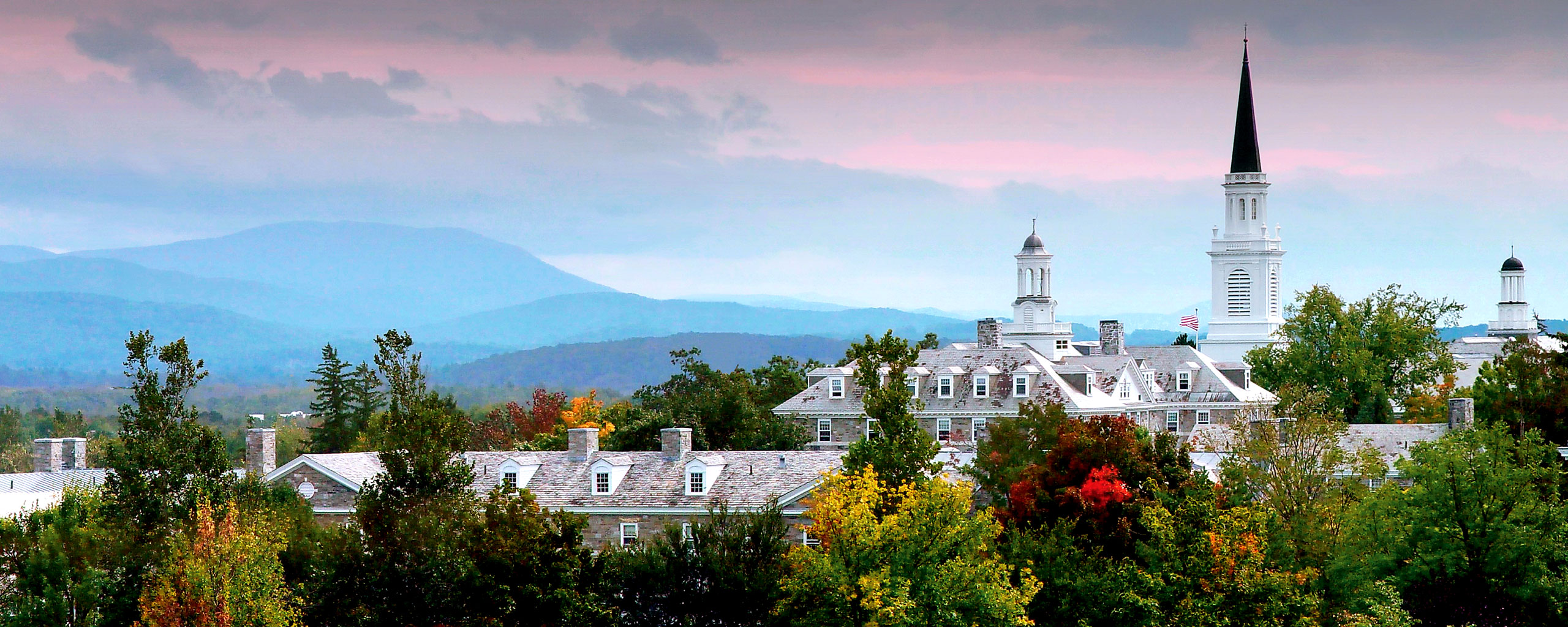
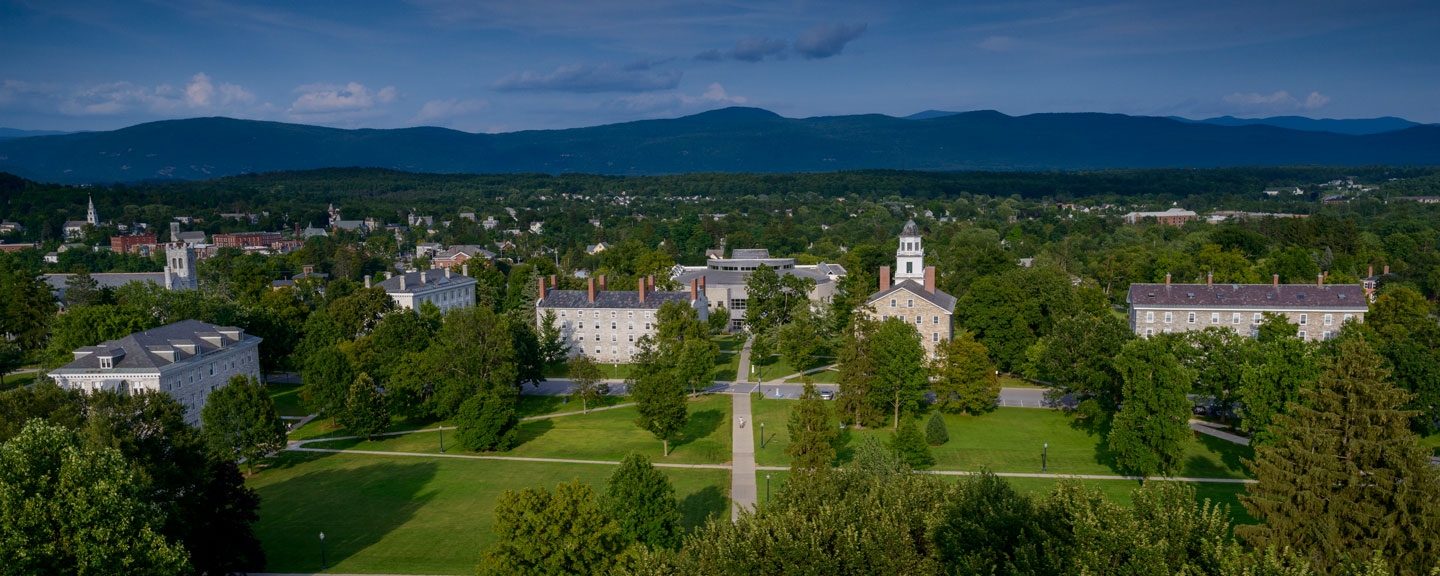
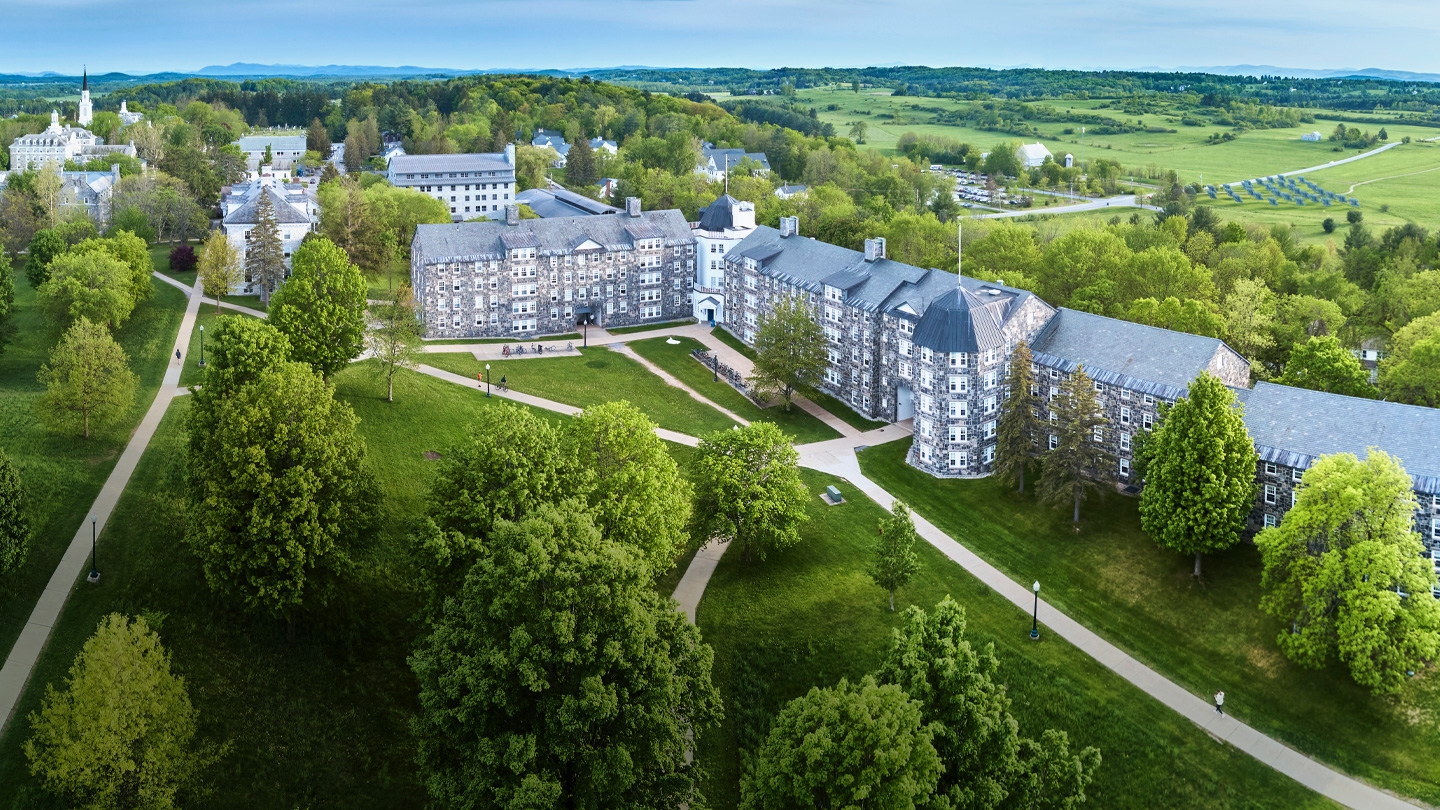
Middlebury College is a fiercely intellectual, outdoorsy liberal arts enclave in Vermont's Champlain Valley, known for its rigorous academics, global outlook, and a campus culture that oscillates between intense study and rugged recreation. Its identity is defined by a deep commitment to environmental studies and language immersion (it founded the famed Language Schools), a collaborative but demanding academic environment, and a student body that is both high-achieving and unpretentiously active. While its remote location fosters a tight-knit, self-contained community, it also shapes a social life that is more about friendships and campus traditions than a bustling college town.
Admission requirements
Test-optional — scores considered if submitted
Required
High school transcript
Letters of recommendation
TOEFL (non-native English)
Considered (not required)
Grade point average
Class rank
Test scores (SAT/ACT)
College-prep program
Demonstrated competencies
Source: IPEDS Admissions survey (2022) via Urban Institute. Covers formal factors only — it does not reflect essays, extracurriculars, or other holistic criteria.
More details
Undergrad enrollment
2,738
In-state tuition
$67,600
Out-of-state tuition
$67,600
No-Loan Policy
Yes, aid packages are grant-based
Graduation Rate
91%
Meets Full Need
Yes, for all admitted students (domestic & international)
ED Share of Class
Significant (409 of 1,341 ED applicants admitted for Class of 2030)
2.4 / 3.0Meets the federal financial-responsibility standard
U.S. Dept. of Education Financial Responsibility Composite Score (FY2022-23). Scale −1.0 to 3.0; ≥1.5 meets the standard. Reported for private nonprofit & for-profit institutions only — public universities are state-backed and not scored, so this is a stability signal, not a ranking.
Top-earning majors
Median earnings by field of study (highest credential), ~2 years after completion.
Economics$75,518
Computer Science$58,673
International Relations and National Security Studies$55,964
Area Studies$44,091
Psychology, General$42,682
Natural Resources Conservation and Research$42,188
Applicants here also applied to
The schools that most often appear alongside Middlebury on applicants’ lists, from our self-reported outcomes corpus.
Co-application frequency from self-reported results — directional peer discovery, not a recommendation.
Campus & location
Campus safety
On-campus violent crimes (2024)
6
Per 1,000 students
2.16
On-campus criminal offenses classed as violent (murder/non-negligent manslaughter, rape, robbery, aggravated assault) for the most recent reported year. Source: U.S. Dept. of Education Campus Safety and Security (Clery Act). Counts reflect what’s reported to the school, and urban campuses often report more partly due to non-student incidents nearby — read alongside campus size and setting, not as a standalone safety verdict.
Climate
Pleasant days / yr
91
Summer high
79°F
Winter low
18°F
Annual rain
45.8"
Annual snow
52.1"
Natural-hazard risk
Very Low
Pleasant days counts days per year with a mean temperature of 55–75°F, a high at or below 90°F, a low at or above 45°F, and little precipitation — a transparent comfort measure, not a weighting we invented. Computed from Open-Meteo ERA5 daily history (2019–2023). Natural-hazard risk is the county’s composite rating from the FEMA National Risk Index.
Deep dive — research, future-scholar output & economic mobility▾
Research output
Institutional h-index
183
Scholarly works
7,005
Institutional research volume and impact from OpenAlex. The h-index reflects large research universities and will be low for teaching-focused liberal-arts colleges — not a measure of undergraduate quality.
Share of this school’s graduates who go on to earn research doctorates (2010–20), by national rank and per-capita yield (NSF institutional-yield ratio). A signal of a research-oriented student culture — not a causal promise, since it partly reflects who enrolls. Only top producers appear. Source: NSF NCSES, Baccalaureate Origins of U.S. Research Doctorate Recipients.
Economic mobility
Mobility rate
1.3%
Bottom → top quintile
Quick answers
What is the acceptance rate at Middlebury College?
Middlebury College's acceptance rate is approximately 11% (Middlebury, VT), based on the most recent figures we compiled from public and primary sources.
What SAT score do you need for Middlebury College?
Admitted students at Middlebury College typically score 1445–1550 on the SAT (the middle-50% range). Scores outside this band are still admitted, especially with strong applications.
How much does Middlebury College cost?
At Middlebury College, the average net price (after aid) is about $31,483 per year. Actual cost varies with financial aid and residency.
How many undergraduates attend Middlebury College?
Middlebury College enrolls approximately 2,738 undergraduate students.
Where is Middlebury College located?
Middlebury College is located in Middlebury, VT.
Admissions
Middlebury's admissions process is highly selective and holistic, with a clear strategic advantage for those who apply through binding Early Decision. For the Class of 2029, the overall was reported at 13.9%, though the college's published selectivity often hovers around 11%. The middle 50% SAT range for admitted students is 1445–1550. The college has been since 2020, and for the Class of 2029, 44% of applicants chose not to submit test scores. Demonstrated interest is not formally tracked in the admissions process, according to independent counseling sources, though engagement is encouraged. The most significant data point for applicants is the Early Decision advantage: across two binding rounds, 1,341 students applied for the Class of 2030 and 409 were admitted, yielding an overall ED acceptance rate of 30.5%. This is substantially higher than the regular decision rate, indicating that Middlebury fills a significant portion of its class through ED. The admissions committee considers a student's academic record (rigor, GPA, class rank), standardized test scores (if submitted), essays, recommendations, extracurricular activities, and character/personal qualities as "very important" factors. For the Class of 2028, early decision applications increased by 4.9% while regular decision applications decreased by 6.8%.
Earnings = median of students working ~10 years after entry; debt = median of graduates. Value divides 10-yr earnings by one year’s net price — read it as earnings per dollar of annual cost, not a full lifetime ROI; it favors lower-cost schools. Source: U.S. Dept. of Education College Scorecard. Figures lag ~2 years and reflect all students, not your intended major.
Political Science and Government
$41,025
Sociology$41,007
Source: U.S. Dept. of Education College Scorecard (field-of-study earnings). Figures cover graduates who received federal aid and lag ~2 years; not all programs report data.
Mobility rate = the share of students who both start in the bottom household-income quintile and reach the top quintile; bottom → top is that chance conditional on starting at the bottom. Source: Opportunity Insights Mobility Report Cards (Chetty, Friedman, Saez, Turner & Yagan). Reflects 1980–82 birth cohorts, so it’s directional, not current.
Middlebury offers a classic, intensive liberal arts curriculum across more than 50 majors and minors, with a particular reputation for strength in environmental studies, international studies, and languages. The academic culture is known for being demanding and requiring a significant time commitment; students describe the difference as "Middlebury requires more time because it requires more work." The most popular majors, by percentage of degrees conferred, are Econometrics and Quantitative Economics (14%), Environmental Studies (8%), Computer Science (7%), and Neuroscience (7%). The college encourages global thinking and is most known for its programs in environmental science, English, and international studies. Its language instruction is legendary, rooted in the college's own summer Language Schools, which pioneered the immersive "language pledge." This global focus permeates the curriculum, with strong offerings in area studies and opportunities for study abroad. The workload is substantial, fostering a collaborative but serious intellectual environment where students are deeply engaged with their coursework and professors.
Life at Middlebury is defined by its stunning but remote Vermont setting. The campus community is described as "distinctive, energetic, and welcoming" and characterized by strong friendships. The social scene is largely campus-centric, driven by college-sponsored events, outdoor activities (skiing, hiking, cycling), and student organizations. There is no Greek life. The location means the campus can feel quiet and self-contained during the week, with students noting it seems "very quiet and a bit lonely" when compared to urban campuses. However, this fosters a tight-knit atmosphere where students create their own fun. Traditions are important, including the weekly, student-run "Dolci" dinner—a five-course, restaurant-style culinary experience in a dining hall that is a beloved and "best-kept secret." The outdoors are a central part of the culture, with the nearby Green Mountains and Lake Champlain serving as the campus's extended playground. Student reviews highlight campus life as being rich in clubs, athletics (Division III Panthers), and a strong sense of community, albeit with the understanding that you won't find a vibrant off-campus bar or restaurant scene. It's a place for students who are comfortable, even eager, to be immersed in a residential college environment where the campus itself is the hub of social and intellectual life.
Middlebury graduates achieve strong outcomes, characterized by high graduation rates and solid earning potential. The college's six-year graduation rate is exceptionally high, reported at 93% or 94% in different sources. According to the provided CANONICAL FIGURES, the graduation rate is 91%. Earnings data shows positive trajectories: median earnings one year after graduation are reported at approximately $50,392, while earnings five years after graduation rise to around $77,212. The CANONICAL FIGURE for median earnings 10 years after entry is $76,310. Other sources note early career average salaries of about $70,000. A significant 80% of Middlebury graduates earn more than a typical high school graduate. These figures reflect the value of the liberal arts degree from a selective institution and the strong career support and alumni network the college provides.
Middlebury is one of a small group of colleges that is both need-blind in admissions for domestic students and meets 100% of the demonstrated financial need for all admitted students, including international students. This is a cornerstone of its affordability promise. However, due to its high sticker price, only about 51% of students receive any form of financial aid. For those who do qualify, the aid packages are substantial and composed primarily of grants and scholarships that do not need to be repaid. The average annual institutional grant is over $62,860, and the average total financial aid offer exceeds $67,000. The —the average cost after grants and scholarships—is a critical figure. While one source lists it at $27,983, the provided CANONICAL FIGURE for the average net price after aid is $31,483. The college emphasizes that almost all its financial aid is given in the form of grants and scholarships, not loans, making it a "no-loan" institution for students with demonstrated need. Families are encouraged to use the college's net price calculator for a personalized estimate.
Middlebury carves out a unique niche in the landscape of elite liberal arts colleges through a powerful combination of place, purpose, and pedagogical intensity. Its identity is inextricably linked to its Vermont environment, making it a haven for students who are as serious about hiking the Long Trail as they are about deconstructing Proust. Academically, it is not just a strong liberal arts college; it is the college for certain pursuits. Its leadership in environmental studies is born from its location and institutional commitment. Its language programs are not merely departments but are supported by a world-renowned immersive institute it created. This creates an academic culture that is both broad and deep, attracting students with specific, often globally-oriented, intellectual passions. Furthermore, its admissions and financial aid policies are a statement of principle: need-blind admission and a guarantee to meet full need for all admits, including international students, places it in a very exclusive category and reflects a commitment to socioeconomic diversity. The result is a campus of driven, outdoorsy, and globally-minded students who form a cohesive community partly by necessity (given the remote location) and partly by shared values. It's for the student who wants the intellectual firepower of a top-tier college without the pretense, and who sees the mountains not as a backdrop, but as an essential part of the curriculum.
Middlebury College seal · sourceMiddlebury College - Profile, Rankings and Data | US News Best Colleges · sourceAbout Middlebury | Middlebury · sourceAdmissions | Middlebury College · source