Admit rate has ranged 44%–52% over the last 5 years. Source: IPEDS via Urban Institute.
Acceptance & SAT from Common Data Set / IPEDS; net price, earnings & graduation from the U.S. Dept. of Education College Scorecard. Figures lag ~1–2 years — verify with the school.
A powerhouse public research university with a suburban-D.C. location, Maryland punches far above its weight in tech, engineering, and policy. It draws high-achieving students (SATs 1400–1530) who want Big Ten spirit alongside serious academics—especially in computer science, home to co-founder Sergey Brin, and aerospace through deep NASA ties. With an 89% graduation rate, Terps typically earn strong salaries, leveraging that capital adjacency for top internships and careers.
Admission requirements
Test-optional — scores considered if submitted
Required
High school transcript
Letters of recommendation
TOEFL (non-native English)
Considered (not required)
Grade point average
Class rank
Test scores (SAT/ACT)
College-prep program
Demonstrated competencies
Source: IPEDS Admissions survey (2022) via Urban Institute. Covers formal factors only — it does not reflect essays, extracurriculars, or other holistic criteria.
More details
Undergrad enrollment
30,760
In-state tuition
$11,809
Out-of-state tuition
$41,186
Graduation Rate
86%
Median Early Career Salary
$56,509
Outcomes & value
Outcomes & value
Median earnings (10 yr)
$82,860
Value (earnings ÷ net price)
5.3×
Median debt at graduation
$19,000
Graduation rate
89%
First-year retention
96%
Reducing loan balance (3 yr)
79%
Pell (lower-income) share
19%
First-gen share (among federal-aid recipients)
22%
Top-earning majors
Median earnings by field of study (highest credential), ~2 years after completion.
Computer and Information Sciences, General$84,653
Computer Engineering$80,466
Agricultural Engineering$73,164
Management Sciences and Quantitative Methods$72,762
Electrical, Electronics, and Communications Engineering$71,761
Engineering, Other$69,897
Applicants here also applied to
The schools that most often appear alongside Maryland on applicants’ lists, from our self-reported outcomes corpus.
On-campus criminal offenses classed as violent (murder/non-negligent manslaughter, rape, robbery, aggravated assault) for the most recent reported year. Source: U.S. Dept. of Education Campus Safety and Security (Clery Act). Counts reflect what’s reported to the school, and urban campuses often report more partly due to non-student incidents nearby — read alongside campus size and setting, not as a standalone safety verdict.
Climate
Pleasant days / yr
86
Summer high
86°F
Winter low
31°F
Annual rain
56.7"
Annual snow
11"
Natural-hazard risk
Relatively Moderate
Pleasant days counts days per year with a mean temperature of 55–75°F, a high at or below 90°F, a low at or above 45°F, and little precipitation — a transparent comfort measure, not a weighting we invented. Computed from Open-Meteo ERA5 daily history (2019–2023). Natural-hazard risk is the county’s composite rating from the FEMA National Risk Index.
Deep dive — research, future-scholar output & economic mobility▾
Research output
Institutional h-index
1,341
Scholarly works
241,207
Institutional research volume and impact from OpenAlex. The h-index reflects large research universities and will be low for teaching-focused liberal-arts colleges — not a measure of undergraduate quality.
Future-scholar output
Science & engineering PhDstop 15 nationally
Humanities & social-science PhDstop 35 nationally
Share of this school’s graduates who go on to earn research doctorates (2010–20), by national rank and per-capita yield (NSF institutional-yield ratio). A signal of a research-oriented student culture — not a causal promise, since it partly reflects who enrolls. Only top producers appear. Source: NSF NCSES, Baccalaureate Origins of U.S. Research Doctorate Recipients.
Quick answers
What is the acceptance rate at University of Maryland-College Park?
University of Maryland-College Park's acceptance rate is approximately 45% (College Park, MD), based on the most recent figures we compiled from public and primary sources.
What SAT score do you need for University of Maryland-College Park?
Admitted students at University of Maryland-College Park typically score 1400–1530 on the SAT (the middle-50% range). Scores outside this band are still admitted, especially with strong applications.
How much does University of Maryland-College Park cost?
At University of Maryland-College Park, the average net price (after aid) is about $15,678 per year. Actual cost varies with financial aid and residency.
How many undergraduates attend University of Maryland-College Park?
University of Maryland-College Park enrolls approximately 30,760 undergraduate students.
Where is University of Maryland-College Park located?
University of Maryland-College Park is located in College Park, MD.
Admissions
UMD is selective but not cutthroat, with a 44.8% for Fall 2025 (66,000 applications for 5,028 spots). The middle 50% SAT range is 1410–1520, ACT 32–35, and weighted GPAs average 4.44. since 2021, the university emphasizes —95% of admitted students had GPAs above 3.75. Enrollment is 23%, suggesting many admitted students treat UMD as a safety or target school. Notably, the admit rate varies significantly by program, with computer science and engineering being most competitive.
Earnings = median of students working ~10 years after entry; debt = median of graduates. Value divides 10-yr earnings by one year’s net price — read it as earnings per dollar of annual cost, not a full lifetime ROI; it favors lower-cost schools. Source: U.S. Dept. of Education College Scorecard. Figures lag ~2 years and reflect all students, not your intended major.
Mechanical Engineering$69,691
Finance and Financial Management Services$68,079
Source: U.S. Dept. of Education College Scorecard (field-of-study earnings). Figures cover graduates who received federal aid and lag ~2 years; not all programs report data.
Co-application frequency from self-reported results — directional peer discovery, not a recommendation.
UMD offers 300+ degree programs, with standouts in computer science (Google co-founder Sergey Brin’s alma mater), engineering (NASA partnerships), journalism (Washington Post pipeline), and public policy (D.C. proximity). The curriculum emphasizes hands-on learning—students routinely intern at NIH, NASA, and Capitol Hill. Rankings consistently place it among the top 20 public universities, with particular strength in aerospace engineering (NASA-funded research) and cybersecurity (NSA-designated Center of Excellence). The Clark School of Engineering and Robert H. Smith School of Business are particularly renowned.
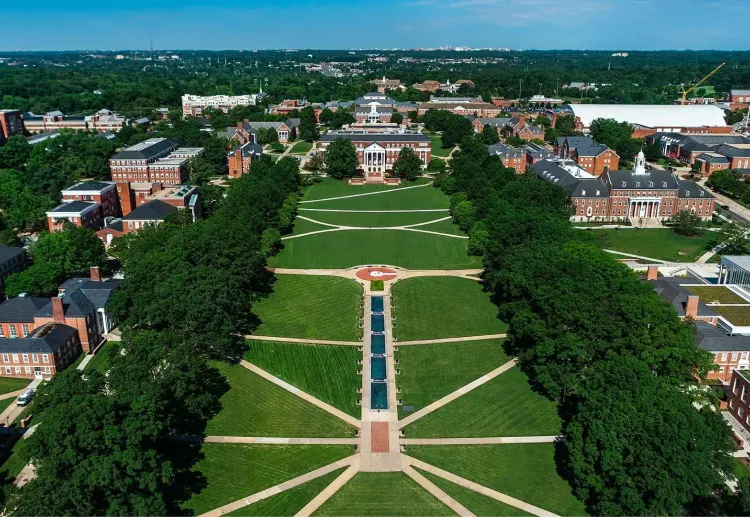
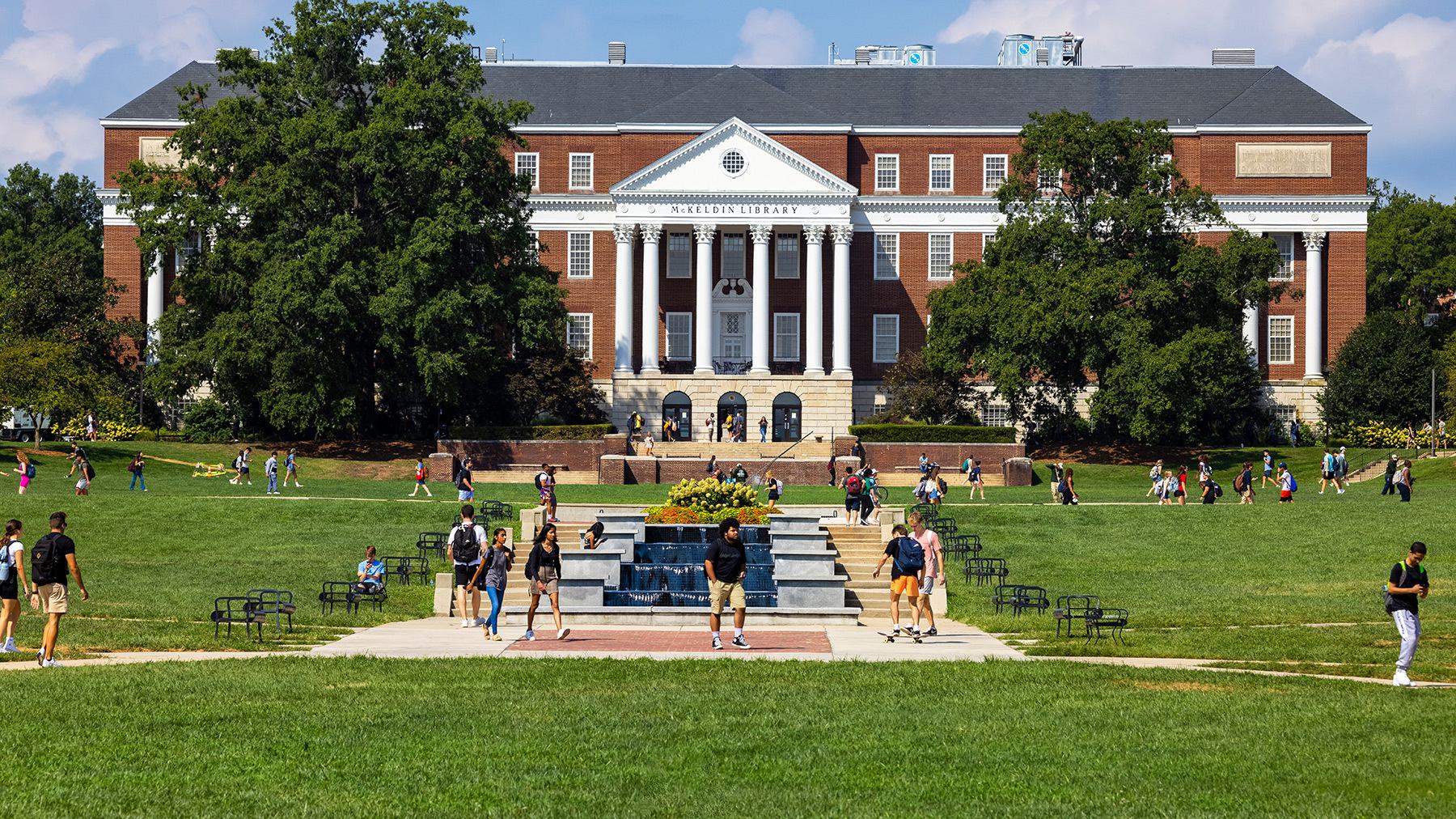
Big Ten energy meets D.C. ambition—39% of students live on the sprawling 1,250-acre campus, while 61% commute or live in nearby College Park. The vibe is collaborative but high-energy, with 800+ clubs (including a top-ranked mock trial team) and Division I athletics (Terrapins basketball games are legendary). Greek life influences but doesn’t dominate social scenes. The Metro-accessible location means students intern by day (White House, NIH, NSA) and party by night at D.C. clubs or campus ragers. Dining halls are surprisingly good, especially the famous Maryland Dairy creamery.
UMD delivers strong ROI—86% graduate within six years (40% above national average), with mid-career salaries averaging $80,584 (79% above peers). Early-career earnings hit $56,509, boosted by D.C. connections: 25% of grads work in government/policy, 20% in tech (Amazon and Google heavily recruit here). The computer science program is particularly lucrative, with graduates averaging $110K+ starting salaries. Alumni networks are powerful in the Mid-Atlantic, especially in engineering (Northrop Grumman, Lockheed Martin) and media (ESPN, NPR).
In-state tuition is $10,490 ($36,000 for out-of-state), with a averaging $16,210 after aid. The university meets 80% of demonstrated need, primarily through grants (Maryland Promise covers full tuition for families earning under $30K). Merit scholarships like the Banneker/Key (full ride) are highly competitive. Notably, 45% of students graduate debt-free, and those who borrow average $22,000 in loans—below the national average. The ROI is especially strong for STEM majors, with engineering grads recouping costs within 5 years.
UMD uniquely blends Big Ten school spirit with Ivy-level academics in select fields—its computer science and engineering programs rival privates at a fraction of the cost. The D.C. adjacency is transformative: students intern at the Pentagon by sophomore year, then watch Supreme Court arguments over lunch. Quirks like Testudo the terrapin mascot and "Midnight Madness" basketball rituals balance the intense academics. For STEM students wanting high ROI or policy wonks craving Capitol Hill access, few publics match Maryland’s combo of rankings, location, and Terrapin pride.
University of Maryland-College Park logo · sourceGreater College Park | Home · sourceUniversity of Maryland, College Park - Profile, Rankings and Data | US News Best Colleges · sourceVisit | University of Maryland · source