Admit rate has ranged 4%–7% over the last 5 years. Source: IPEDS via Urban Institute.
Acceptance & SAT from Common Data Set / IPEDS; net price, earnings & graduation from the U.S. Dept. of Education College Scorecard. Figures lag ~1–2 years — verify with the school.
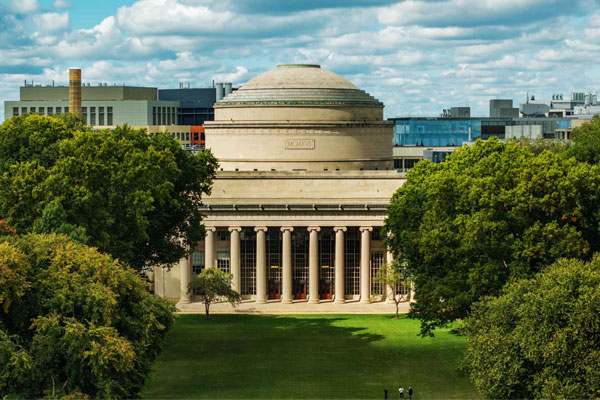
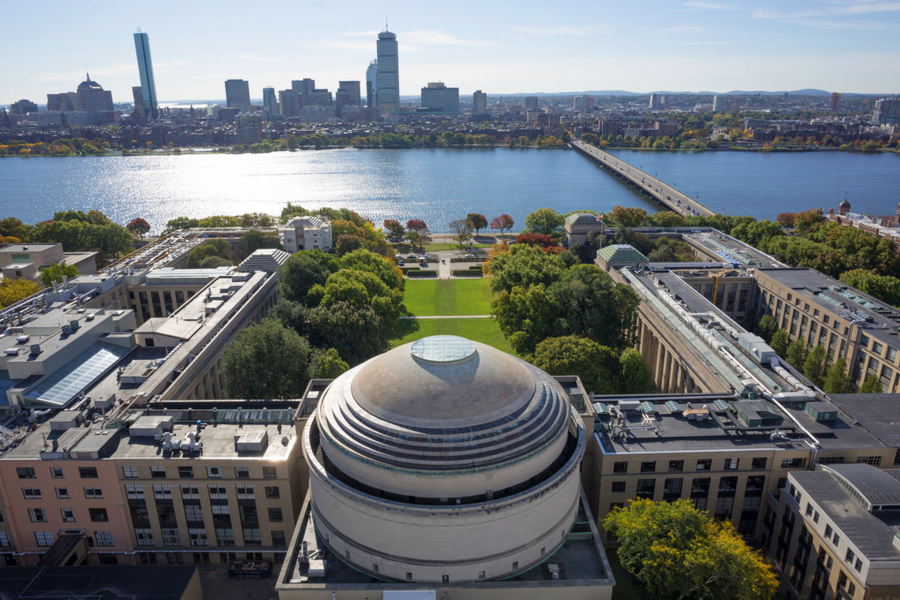
The Massachusetts Institute of Technology isn't just a top engineering school; it's a high-intensity, collaborative pressure cooker for the world's most obsessive problem-solvers. On the banks of the Charles River, MIT combines a legendary, hands-on curriculum—ranked #1 in Engineering and Computer Science—with a famously quirky, collaborative student culture defined by hackathons, over 500 student clubs, and a 'work hard, play hard' ethos. The payoff is stark: graduates command some of the highest median earnings in the nation, backed by an ironclad financial aid policy that meets 100% of need with no loans.
Admission requirements
Test scores required
Required
High school transcript
Letters of recommendation
Test scores (SAT/ACT)
Considered (not required)
Grade point average
Class rank
College-prep program
TOEFL (non-native English)
Source: IPEDS Admissions survey (2022) via Urban Institute. Covers formal factors only — it does not reflect essays, extracurriculars, or other holistic criteria.
Key deadlines (2026-2027)
Early Action — Early Action
November 1, 2026
Regular Decision — Regular Action
January 5, 2027
Financial Aid — CSS Profile & FAFSA Priority Deadline
February 15, 2027
More details
Undergrad enrollment
4,535
In-state tuition
$62,396
Out-of-state tuition
$62,396
No-Loan Policy
Yes
Graduation Rate
96%
Meets Full Need
Yes
First-Year Retention
99.8%
Demonstrated Interest
Not considered
Median Earnings (10yr)
$143,372
Outcomes & value
Outcomes & value
Median earnings (10 yr)
$143,372
Value (earnings ÷ net price)
7.1×
Median debt at graduation
$14,768
Graduation rate
96%
First-year retention
99%
Reducing loan balance (3 yr)
92%
Pell (lower-income) share
19%
First-gen share (among federal-aid recipients)
26%
Top-earning majors
Median earnings by field of study (highest credential), ~2 years after completion.
Computer Science$127,993
Electrical, Electronics, and Communications Engineering$121,226
Mathematics$117,572
Economics$110,878
Biomathematics, Bioinformatics, and Computational Biology$94,408
Business/Commerce, General$94,408
Applicants here also applied to
The schools that most often appear alongside MIT on applicants’ lists, from our self-reported outcomes corpus.
Co-application frequency from self-reported results — directional peer discovery, not a recommendation.
Campus & location
Campus safety
On-campus violent crimes (2024)
6
Per 1,000 students
0.50
On-campus criminal offenses classed as violent (murder/non-negligent manslaughter, rape, robbery, aggravated assault) for the most recent reported year. Source: U.S. Dept. of Education Campus Safety and Security (Clery Act). Counts reflect what’s reported to the school, and urban campuses often report more partly due to non-student incidents nearby — read alongside campus size and setting, not as a standalone safety verdict.
Climate
Pleasant days / yr
91
Summer high
81°F
Winter low
25°F
Annual rain
49"
Annual snow
31.4"
Natural-hazard risk
Relatively High
Pleasant days counts days per year with a mean temperature of 55–75°F, a high at or below 90°F, a low at or above 45°F, and little precipitation — a transparent comfort measure, not a weighting we invented. Computed from Open-Meteo ERA5 daily history (2019–2023). Natural-hazard risk is the county’s composite rating from the FEMA National Risk Index.
Deep dive — research, future-scholar output & economic mobility▾
Research output
Institutional h-index
2,254
Scholarly works
346,338
Institutional research volume and impact from OpenAlex. The h-index reflects large research universities and will be low for teaching-focused liberal-arts colleges — not a measure of undergraduate quality.
Share of this school’s graduates who go on to earn research doctorates (2010–20), by national rank and per-capita yield (NSF institutional-yield ratio). A signal of a research-oriented student culture — not a causal promise, since it partly reflects who enrolls. Only top producers appear. Source: NSF NCSES, Baccalaureate Origins of U.S. Research Doctorate Recipients.
Economic mobility
Mobility rate
3.4%
Quick answers
What is the acceptance rate at Massachusetts Institute of Technology?
Massachusetts Institute of Technology's acceptance rate is approximately 5% (Cambridge, MA), based on the most recent figures we compiled from public and primary sources.
What SAT score do you need for Massachusetts Institute of Technology?
Admitted students at Massachusetts Institute of Technology typically score 1520–1580 on the SAT (the middle-50% range). Scores outside this band are still admitted, especially with strong applications.
How much does Massachusetts Institute of Technology cost?
At Massachusetts Institute of Technology, the average net price (after aid) is about $20,111 per year. Actual cost varies with financial aid and residency.
How many undergraduates attend Massachusetts Institute of Technology?
Massachusetts Institute of Technology enrolls approximately 4,535 undergraduate students.
Where is Massachusetts Institute of Technology located?
Massachusetts Institute of Technology is located in Cambridge, MA.
Admissions
Gaining entry to MIT is one of the most formidable challenges in American higher education, with an hovering around 5%. The institute received 29,281 first-year applications for a recent cycle, admitting just 1,334 students. The process is need-blind for domestic applicants and focuses intensely on academic rigor and character. MIT employs a non-binding Early Action plan, which historically shows a slightly higher acceptance rate than Regular Decision—figures around 5.26% for Early Action versus approximately 3.2% for Regular Decision for U.S. citizens have been reported. Crucially, MIT's indicates that demonstrated interest is not considered in admissions decisions; visiting campus or contacting admissions officers won't help an application. The evaluation is holistic but anchored by an applicant's academic record. The middle 50% SAT range for admitted students is exceptionally high, typically 1520–1580, with a similar ACT range of 34–36. The admissions office can be reached at 617-253-3400 or [email protected].
Earnings = median of students working ~10 years after entry; debt = median of graduates. Value divides 10-yr earnings by one year’s net price — read it as earnings per dollar of annual cost, not a full lifetime ROI; it favors lower-cost schools. Source: U.S. Dept. of Education College Scorecard. Figures lag ~2 years and reflect all students, not your intended major.
Physics$84,653
Aerospace, Aeronautical, and Astronautical/Space Engineering$83,177
Source: U.S. Dept. of Education College Scorecard (field-of-study earnings). Figures cover graduates who received federal aid and lag ~2 years; not all programs report data.
Mobility rate = the share of students who both start in the bottom household-income quintile and reach the top quintile; bottom → top is that chance conditional on starting at the bottom. Source: Opportunity Insights Mobility Report Cards (Chetty, Friedman, Saez, Turner & Yagan). Reflects 1980–82 birth cohorts, so it’s directional, not current.
MIT's academic identity is built on a relentless, hands-on foundation in science, mathematics, and technology, though its scope has grown to include prominent programs in economics, management, architecture, and the humanities. The institute is consistently ranked #1 in Engineering and Computer Science nationally. All undergraduates ground their studies in a core curriculum of science, math, and humanities before diving into one of the institute's rigorous majors, which range from Biological Engineering (Course 20) and Biology (Course 7) to Asian and Asian Diaspora Studies (Course 21). There is no grade inflation; the academics are famously demanding and designed to push students to expand their intellectual horizons. The largest school remains Engineering, reflecting the institute's historic strength, but the education is broadly based, requiring engagement with the arts, humanities, and social sciences. The culture is one of intense curiosity applied to real-world problems, where theoretical knowledge is constantly tested through experimentation and building.
Life at MIT is a whirlwind of intense collaboration and creative chaos, far from the stereotype of solitary lab work. The campus buzzes with activity from over 500 student organizations, including everything from hackathons and a cappella groups to clubs dedicated to chocolate science. Nearly 40 Greek-letter and independent living groups provide additional social and residential options. The student culture is often described as 'collaboratively competitive'—everyone is driven to excel, but there's a strong ethos of working together so no one is left behind. This supportive, if demanding, community is a hallmark, with one student noting, 'The community is very collaborative!' MIT has long been a home for diverse identities, hosting one of the nation's oldest LGBTQ+ student groups and numerous cultural organizations. With chaplains for more than 20 faith traditions and a constant calendar of events, the institute fosters a vibrant, if exhausting, ecosystem where intellectual passion spills over into every aspect of life.
An MIT degree is a powerful financial and professional engine. The institute boasts a 96% graduation rate, placing it in the top 5% of institutions nationally. More impressively, the freshman retention rate is an astonishing 99.8%, indicating near-universal student satisfaction after the first year. The career outcomes are exceptional. MIT's Career Advising & Professional Development office tracks strong post-graduate salaries, geographical distribution, and top hiring companies. While various sources cite high early-career median salaries (e.g., $110,000), the long-term financial return is crystal clear: MIT graduates have a median earnings figure of $143,372 ten years after entry. This powerful outcome, combined with a supportive alumni network and the institute's global reputation, means an MIT education typically pays for itself in a remarkably short timeframe.
MIT is aggressively committed to affordability, ensuring that admitted students can attend regardless of financial background. The institute meets 100% of the demonstrated financial need of every undergraduate for all four years. Crucially, it does so with a no-loan policy; aid packages are composed entirely of grants and scholarships, not debt. This policy is supported by the institute's substantial endowment. The result is a dramatically reduced for most families. For the 2024-2025 academic year, the median annual price paid by an undergraduate who received an MIT Scholarship was $10,268. The average net price after aid is $20,111. Overall, 57% of undergraduates are awarded an MIT Scholarship. Families are encouraged to use the institute's Net Price Calculator for a personalized estimate, as aid is awarded solely based on financial need.
MIT stands apart not merely for its rankings, but for its unique cultural alchemy: it takes the world's most brilliant, often unconventional, technical minds and immerses them in a culture of intense, practical collaboration. This is not a place of pure theory; it's a maker-space on an institutional scale, where the ethos is 'mens et manus' (mind and hand). The combination is potent. The academic pressure is legendary, but it's counterbalanced by a student body that collectively revels in solving impossible problems, whether for a psets (problem sets), a hackathon, or a chocolate science club. This creates graduates who are not just knowledgeable but are resilient, inventive, and adept at building real things. Furthermore, MIT backs its mission with unparalleled financial commitment, removing economic barriers through its no-loan, full-need-met aid policy. The outcome is a self-reinforcing ecosystem: exceptional need-blind access produces extraordinary talent, which in turn generates the groundbreaking innovations and high earnings that burnish the institute's reputation and fuel its endowment. It is a closed loop of excellence, accessibility, and impact.
Massachusetts Institute of Technology seal · sourceCampus of the Massachusetts Institute of Technology - Wikipedia · sourceMIT - Massachusetts Institute of Technology · sourceMIT named No. 5 university by U.S. News | MIT News | Massachusetts Institute of Technology · source