Admit rate has ranged 65%–74% over the last 5 years — notably volatile. Source: IPEDS via Urban Institute.
Acceptance & SAT from Common Data Set / IPEDS; net price, earnings & graduation from the U.S. Dept. of Education College Scorecard. Figures lag ~1–2 years — verify with the school.
The University of Delaware operates like a flagship public university with the academic breadth and research punch of a major private institution, all set in a classic college town. It’s a place where a strong party culture and vibrant Greek life coexist with a surprisingly robust graduation rate and a slate of signature programs in engineering, business, and the sciences. For Delaware residents, it's an accessible state school with a generous aid promise; for everyone else, it's a popular, moderately selective out-of-state destination where the social scene is as much a draw as the academics.
Admission requirements
Test-optional — scores considered if submitted
Required
High school transcript
Grade point average
Letters of recommendation
College-prep program
TOEFL (non-native English)
Considered (not required)
Class rank
Test scores (SAT/ACT)
Demonstrated competencies
Source: IPEDS Admissions survey (2022) via Urban Institute. Covers formal factors only — it does not reflect essays, extracurriculars, or other holistic criteria.
More details
Undergrad enrollment
19,071
In-state tuition
$16,810
Out-of-state tuition
$41,400
No-Loan Policy
Not in sources
Graduation Rate
81%
Meets Full Need
Yes, for in-state families $35k-$75k income
ED Share of Class
Not in sources
First-Year Retention
Not in sources
Demonstrated Interest
Not considered
Median Earnings (10yr)
$72,950
Outcomes & value
Outcomes & value
Median earnings (10 yr)
$72,950
Value (earnings ÷ net price)
4.1×
Median debt at graduation
$24,572
Graduation rate
81%
First-year retention
92%
Reducing loan balance (3 yr)
80%
Pell (lower-income) share
16%
First-gen share (among federal-aid recipients)
17%
Top-earning majors
Median earnings by field of study (highest credential), ~2 years after completion.
Computer and Information Sciences, General$70,176
Registered Nursing, Nursing Administration, Nursing Research and Clinical Nursing$68,698
Management Information Systems and Services$67,101
Chemical Engineering$66,401
Electrical, Electronics, and Communications Engineering$63,005
Mechanical Engineering
Applicants here also applied to
The schools that most often appear alongside Delaware on applicants’ lists, from our self-reported outcomes corpus.
On-campus criminal offenses classed as violent (murder/non-negligent manslaughter, rape, robbery, aggravated assault) for the most recent reported year. Source: U.S. Dept. of Education Campus Safety and Security (Clery Act). Counts reflect what’s reported to the school, and urban campuses often report more partly due to non-student incidents nearby — read alongside campus size and setting, not as a standalone safety verdict.
Climate
Pleasant days / yr
90
Summer high
85°F
Winter low
30°F
Annual rain
54.2"
Annual snow
12.6"
Natural-hazard risk
Relatively High
Pleasant days counts days per year with a mean temperature of 55–75°F, a high at or below 90°F, a low at or above 45°F, and little precipitation — a transparent comfort measure, not a weighting we invented. Computed from Open-Meteo ERA5 daily history (2019–2023). Natural-hazard risk is the county’s composite rating from the FEMA National Risk Index.
Deep dive — research, future-scholar output & economic mobility▾
Research output
Institutional h-index
709
Scholarly works
96,377
Institutional research volume and impact from OpenAlex. The h-index reflects large research universities and will be low for teaching-focused liberal-arts colleges — not a measure of undergraduate quality.
Economic mobility
Mobility rate
0.9%
Bottom → top quintile
39%
From bottom quintile
2%
Mobility rate = the share of students who both start in the bottom household-income quintile and reach the top quintile; bottom → top is that chance conditional on starting at the bottom. Source: Opportunity Insights Mobility Report Cards (Chetty, Friedman, Saez, Turner & Yagan). Reflects 1980–82 birth cohorts, so it’s directional, not current.
Quick answers
What is the acceptance rate at University of Delaware?
University of Delaware's acceptance rate is approximately 71% (Newark, DE), based on the most recent figures we compiled from public and primary sources.
What SAT score do you need for University of Delaware?
Admitted students at University of Delaware typically score 1190–1370 on the SAT (the middle-50% range). Scores outside this band are still admitted, especially with strong applications.
How much does University of Delaware cost?
At University of Delaware, the average net price (after aid) is about $17,799 per year. Actual cost varies with financial aid and residency.
How many undergraduates attend University of Delaware?
University of Delaware enrolls approximately 19,071 undergraduate students.
Where is University of Delaware located?
University of Delaware is located in Newark, DE.
Admissions
Admissions at the University of Delaware are moderately selective, with the process described as "somewhat selective." The university is for all applicants through at least 2025. The admitted student profile for freshmen shows a mid-50% GPA range of 3.68 to 4.22 (weighted) and a mid-50% SAT range of 1240 to 1390. The university receives a high volume of applications, with one source noting 40,000 applications for a recent cycle. The rate—the percentage of admitted students who choose to enroll—was reported as 14.8% for one class, indicating that UD competes for students who have many options. Demonstrated interest is not considered in the admissions process, as explicitly stated in the . The university offers an Early Action option, but sources do not specify an Early Decision program or its associated advantage.
Earnings = median of students working ~10 years after entry; debt = median of graduates. Value divides 10-yr earnings by one year’s net price — read it as earnings per dollar of annual cost, not a full lifetime ROI; it favors lower-cost schools. Source: U.S. Dept. of Education College Scorecard. Figures lag ~2 years and reflect all students, not your intended major.
$62,632
Accounting and Related Services$62,491
Finance and Financial Management Services$60,552
Source: U.S. Dept. of Education College Scorecard (field-of-study earnings). Figures cover graduates who received federal aid and lag ~2 years; not all programs report data.
UD is a major research university that offers students a vast academic menu with more than 150 majors, and the College of Arts and Sciences alone provides more than 170 majors. The curriculum encourages discovery-based learning in labs and in the field. Cross-college programs unite faculty expertise and resources from multiple colleges under a shared identity. The most popular majors for recent graduates are heavily career-oriented: Business, Management, Marketing, and Related Support Services (24%) and Health Professions and Related Programs (11%). Students describe the academic environment as having "great programs" with some large introductory classes, but also note the value of its strong reputation in certain fields. The sheer breadth of options means students can find a niche, from traditional liberal arts to highly specialized pre-professional tracks.
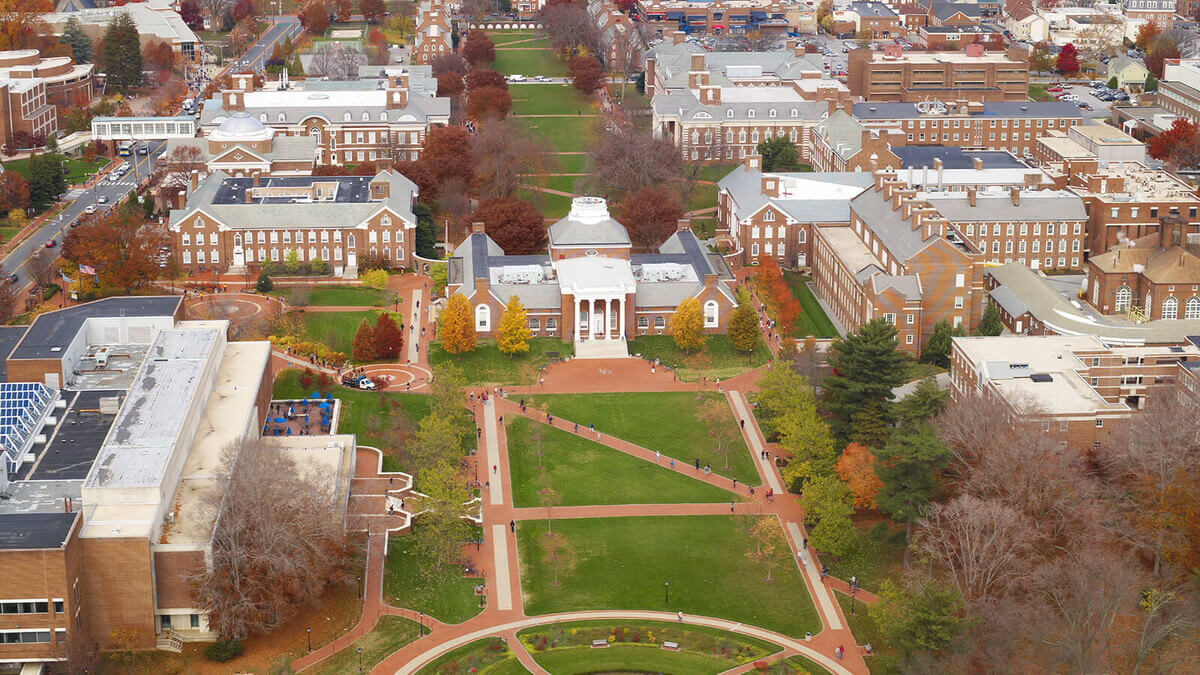
Life at UD is defined by a classic, spirited campus culture in the college town of Newark. The social scene is often described as lively and centered around a strong party culture, with Greek life playing a significant role. The university fosters this through traditions like the Twilight Induction Ceremony, Homecoming, and Senior Week celebrations. Campus housing is not universal; only 37% of students live in college-owned, -operated, or -affiliated housing, while 63% live off campus. Freshmen living on campus are required to have a dining plan, with food described as "average in the halls" but with many good options available on campus. The University Student Centers are hubs for activity, home to more than 400 student groups encompassing creative leadership, innovation, service, and fraternity and sorority life. The Division of Student Life explicitly aims to advance equity and inclusion and drive holistic development.
UD prides itself on strong post-graduation outcomes, with a four-year graduation rate of 73% cited as among the best in the nation. A broader measure shows 94% of students are employed or continuing their education after graduation. More granular data from a recent career outcomes report (with a 77% knowledge rate) shows that of the graduates surveyed, 62% were employed, 29% were continuing their education, and 8% were seeking employment. The university boasts that 91% of graduates from the College of Arts and Sciences are employed or pursuing further education. These figures paint a picture of a university that successfully launches the majority of its students into careers or advanced study shortly after graduation.
Financial aid at UD is need-based, with the FAFSA being the only required application for consideration for university and federal grants and loans. The university has a notable commitment to in-state students from lower- and middle-income families: Delaware residents with family incomes between $35,000 and $75,000 will receive a financial aid package that covers their full tuition and mandatory fees. State law also directs the university to provide financial aid to Delaware residents with demonstrated financial need. For all students, grants—which do not require repayment—are a key component of aid packages. The university offers a Calculator for families to estimate their actual cost. For international students, merit-based awards range from $5,000 to $15,000 per year, and they are also eligible to compete for UD's most prestigious scholarships.
The University of Delaware carves out a distinct identity by blending the energetic, tradition-heavy social life of a big state school with the academic heft and strong outcomes of a private research university. Its 73% four-year graduation rate is unusually high for a public institution and speaks to a supportive environment that gets students to the finish line efficiently. For in-state students, it functions as a true public flagship with a powerful financial aid promise for middle-income families. For the large contingent of out-of-state students, it offers a classic, vibrant college town experience with a vast array of academic programs—particularly in high-demand fields like business and health professions—all under the umbrella of a respected research institution. It’s a place where you can join a fraternity, attend a major football game, and also work in a cutting-edge research lab, a combination that continues to draw tens of thousands of applications each year.
University of Delaware seal · sourceCampus Locations | Graduate College | University of Delaware · sourceUniversity of Delaware — Admissions, Tuition & Acceptance Rate | Appily · sourceUniversity of Delaware Campus Tour - UD Capture | University of Delaware · source