Admit rate has ranged 58%–66% over the last 5 years. Source: IPEDS via Urban Institute.
Acceptance & SAT from Common Data Set / IPEDS; net price, earnings & graduation from the U.S. Dept. of Education College Scorecard. Figures lag ~1–2 years — verify with the school.
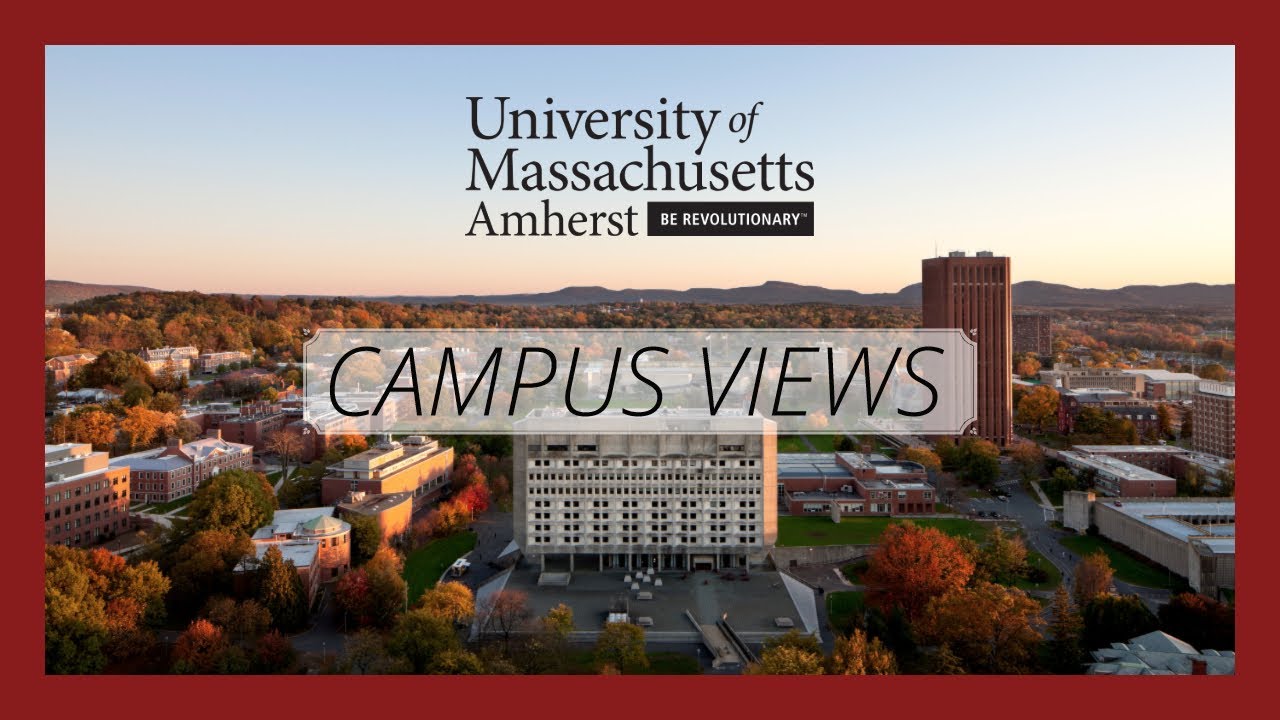
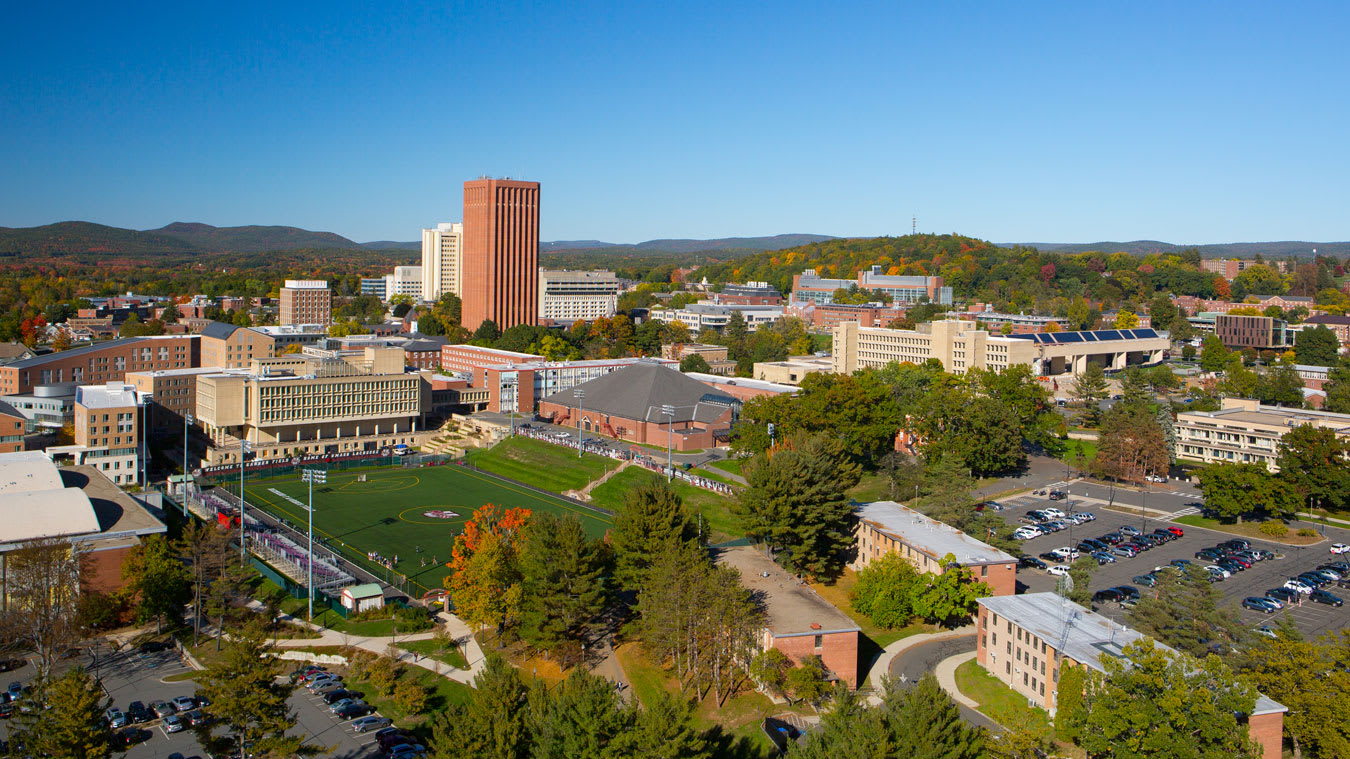
The University of Massachusetts-Amherst is the flagship public research university of Massachusetts, a sprawling, energetic campus in the Pioneer Valley where academic ambition collides with a famously vibrant social scene. It's a place where you can pursue top-ranked programs in computer science and business, then join thousands of students at a weekend party, all while enjoying dining consistently ranked among the nation's best. Think of it as a high-octane, high-value public university that delivers serious research opportunities and career outcomes without taking itself too seriously.
Admission requirements
Test-optional — scores considered if submitted
Required
High school transcript
Grade point average
Letters of recommendation
College-prep program
Demonstrated competencies
TOEFL (non-native English)
Considered (not required)
Class rank
Test scores (SAT/ACT)
Source: IPEDS Admissions survey (2022) via Urban Institute. Covers formal factors only — it does not reflect essays, extracurriculars, or other holistic criteria.
On-campus criminal offenses classed as violent (murder/non-negligent manslaughter, rape, robbery, aggravated assault) for the most recent reported year. Source: U.S. Dept. of Education Campus Safety and Security (Clery Act). Counts reflect what’s reported to the school, and urban campuses often report more partly due to non-student incidents nearby — read alongside campus size and setting, not as a standalone safety verdict.
Climate
Pleasant days / yr
88
Summer high
81°F
Winter low
22°F
Annual rain
51.6"
Annual snow
40"
Natural-hazard risk
Relatively Low
Pleasant days counts days per year with a mean temperature of 55–75°F, a high at or below 90°F, a low at or above 45°F, and little precipitation — a transparent comfort measure, not a weighting we invented. Computed from Open-Meteo ERA5 daily history (2019–2023). Natural-hazard risk is the county’s composite rating from the FEMA National Risk Index.
Deep dive — research, future-scholar output & economic mobility▾
Research output
Institutional h-index
889
Scholarly works
124,822
Institutional research volume and impact from OpenAlex. The h-index reflects large research universities and will be low for teaching-focused liberal-arts colleges — not a measure of undergraduate quality.
Quick answers
What is the acceptance rate at University of Massachusetts-Amherst?
University of Massachusetts-Amherst's acceptance rate is approximately 60% (Amherst, MA), based on the most recent figures we compiled from public and primary sources.
What SAT score do you need for University of Massachusetts-Amherst?
Admitted students at University of Massachusetts-Amherst typically score 1310–1500 on the SAT (the middle-50% range). Scores outside this band are still admitted, especially with strong applications.
How much does University of Massachusetts-Amherst cost?
At University of Massachusetts-Amherst, the average net price (after aid) is about $22,383 per year. Actual cost varies with financial aid and residency.
How many undergraduates attend University of Massachusetts-Amherst?
University of Massachusetts-Amherst enrolls approximately 23,671 undergraduate students.
Where is University of Massachusetts-Amherst located?
University of Massachusetts-Amherst is located in Amherst, MA.
Admissions
UMass Amherst operates as a selective public flagship, with an admissions process that is competitive but accessible, especially for in-state students who make up the overwhelming majority of the class. The university reports an of 60%, with an early acceptance rate of 64.2%. For the most recent incoming class, the average high school GPA was an impressive 4.42, with middle 50% SAT scores of 1310–1500 and ACT scores of 30–33. The admissions office states that the acceptance rate for in-state and out-of-state applicants is nearly identical, both around 60%. The university does not have a binding Early Decision program but offers Early Action; it has not publicly released specific Early Action admission statistics. According to analysis of the , demonstrated interest is not considered in the admissions process. The most important factors are academic: rigor of secondary school record, class rank, GPA, and standardized test scores (which are considered for admission).
Class Profile: The first-year class is predominantly in-state, with 71.6% of students hailing from Massachusetts and 28.4% from out-of-state or internationally.
Application Basics: The regular decision deadline is January 15. A high school diploma is required (a GED is accepted).
Earnings = median of students working ~10 years after entry; debt = median of graduates. Value divides 10-yr earnings by one year’s net price — read it as earnings per dollar of annual cost, not a full lifetime ROI; it favors lower-cost schools. Source: U.S. Dept. of Education College Scorecard. Figures lag ~2 years and reflect all students, not your intended major.
$65,594
Accounting and Related Services$63,646
Civil Engineering$60,903
Source: U.S. Dept. of Education College Scorecard (field-of-study earnings). Figures cover graduates who received federal aid and lag ~2 years; not all programs report data.
Academically, UMass Amherst is a comprehensive research university with a sprawling catalog of over 100 majors, but its culture is particularly defined by strength in STEM, business, and the social sciences. The ten most popular majors for recent graduates highlight where student interest and institutional investment converge: Psychology (8%), Computer Science (7%), Finance (5%), Biology/Biological Sciences (5%), and Communications are at the top. The university promotes programs that prepare students for careers in "human and animal research, animal management, agriculture, and the veterinary sciences." The academic environment is described as "diverse and rigorous," leveraging the scale of a large public university to offer substantial opportunity, though this can sometimes come with large introductory class sizes (the average class size is reported as 35). Faculty are highly qualified, with 95% holding the highest degree in their field. The vibe is pragmatic and career-oriented, with students valuing the direct pathway from strong programs to the job market.
Life at UMass Amherst is defined by its scale, energy, and location in the quintessential college town of Amherst. The social reputation is well-earned: student polls characterize the party scene with "tons of raging parties almost any night of the week" and "lots of options Wednesday-Saturday," solidifying its status as a top party school in Massachusetts. But there's more to the story. The campus buzzes with creativity, featuring galleries, theaters, student groups, and live performances as part of everyday life. Students describe a "great mix of both academics and culture," with easy access to local cafés, global cuisine, and outdoor activities in the surrounding Pioneer Valley. The residential experience is a classic large-university one, with all the associated pros (great facilities, endless social options) and cons (crowded gyms, some aging buildings). The dining program is a major point of pride, consistently ranked among the best in the nation. In essence, it's a campus culture where students are expected to carve out their own niche from a vast array of social and extracurricular options.
UMass Amherst delivers strong return on investment, particularly for a public university. The four-year graduation rate is 75%, rising to an 83% six-year graduation rate. Career outcomes are robust, with median earnings for graduates six years after enrollment reported at $60,347, which is 38% above the national average. More granular salary data shows earnings one year after graduation at $51,780, climbing to $74,615 five years after graduation. As with most large universities, earnings vary significantly by major; for example, history and music graduates earn notably less than the median. The university's large alumni network and strong regional reputation, especially in the Northeast, fuel these outcomes. One college-specific outcomes survey for the College of Social and Behavioral Sciences reported a knowledge rate (awareness of graduate status) of 71% for its graduates.
As a public institution, UMass Amherst offers a significantly lower sticker price for in-state students, with a (average cost after grants and scholarships) of $22,383. The university reports that 75% of full-time, first-year undergraduates receive some form of grant or scholarship aid. The average aid package awarded is $22,429, with the average need-based scholarship or grant being $16,634. The financial aid process is centralized around the FAFSA, which is the only application required to be considered for at UMass Amherst. The priority deadline for filing is March 1; submitting after this date does not affect eligibility for federal aid but may impact campus-based funding. Aid packages are a mix of need-based and non-need-based (merit) awards. The university does not advertise a policy of meeting 100% of demonstrated financial need for all admitted students, nor does it have a universal no-loan policy where loans are replaced with grants.
UMass Amherst stands out for delivering a quintessential, high-energy big-university experience—complete with top-tier dining, a vibrant social scene, and powerhouse Division I athletics—at a public university price point, especially for Massachusetts residents. It avoids the anonymity trap of some large publics by fostering a strong sense of community and school spirit, anchored in its beautiful Pioneer Valley setting. Academically, it punches well above its weight in specific, high-demand fields like computer science, business, and certain health sciences, providing a direct pipeline to strong career outcomes. It’s the choice for students who want the full spectrum of college life—research opportunities, thousands of potential friends, endless clubs, and yes, parties—without the elitism or extreme price tag of a private college. You come here to get a serious education without having to be serious all the time.
University of Massachusetts-Amherst seal · sourceUMass Amherst Campus Views · sourceUniversity of Massachusetts--Amherst (UMass Amherst) - Profile, Rankings and Data | US News Best Colleges · sourceUniversity of Massachusetts Amherst | Partner Portal · source